

Understanding the Pull of Liminal Spaces
Backrooms, Weirdcore, Dead Malls, and Gen Z's Transitional Anxiety

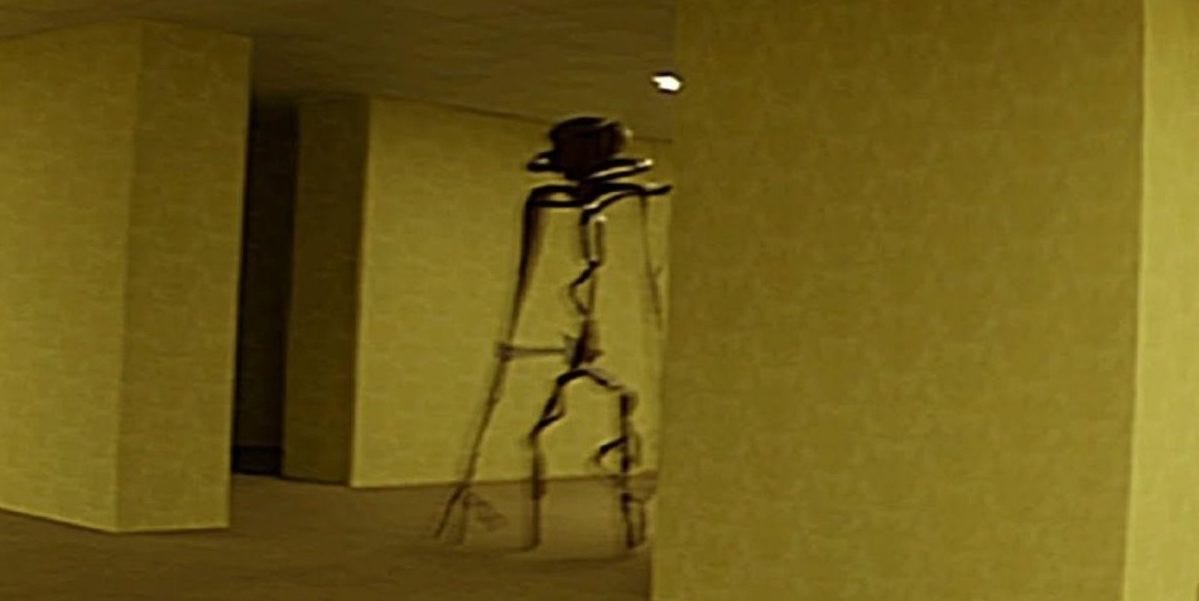
A24 just released its most successful film to perform at the box office, to date, with Kane Parsons’ Backrooms. Directed by a 20-year-old YouTuber, he has become the youngest filmmaker in history to top the domestic box office. It’s now A24’s biggest historic opening, at $81.4 million, having been made just for just $10 million. The excitement and fervor over this movie were somewhat fanatical.
A 20-year-old novice filmmaker’s directorial debut, having only been known for his YouTube channel, just outperformed a fucking Star Wars movie. And it’s not alone. 26-year-old Curry Barker likewise just made his directorial debut in horror with Obsession, and the two have double-mogged Star Wars at the box office. It looks to be a total Zoomer Boy Summer.


I went to see Backrooms one of these past weekends at a packed theater that, unfortunately for me, did not have assigned seating. Like a pack of hyenas (or entities in the backrooms), people scrambled for seats while those already settled clung to their seats, their aisles, their breathing space, insisting a boyfriend or a friend was coming back who never did.
The second the previews flashed on the screen, the theater literally erupted into applause and cheers. “Oh,” I thought, “It’s going to be one of those audiences.” Since I’m not a geriatric Grinch, I found it endearing. Though theater etiquette was poor, between the constant talking and the amateur stand-up ad libs being performed by the painfully unfunny women behind me, it felt like a real communal space that was refreshingly alive, pulsating with passion and interest.
A perfect antithesis to what we were about to watch. An antidote to the atomized nature of post-pandemic humanity. Have we really done it? Are we so back? Did Zoomers reverse-engineer community from first principles? It looks like it’s a Zoomer Cinephile Summer.
But what are the backrooms, and why is a 20-year-old novice filmmaker born in 2005 poetically perfect to adapt them to the big screen?
Origins of The Backrooms
Like most things, it all started on 4chan. In 2019, an anonymous user made this post on a paranormal board called /x/ after the OP had posted the standalone image with a prompt asking for people to share disquieting images that just feel “off.” Building on the original image, the other anon user replied to the thread with a fictional horror story centered around it. To this day, we do not know who posted it.
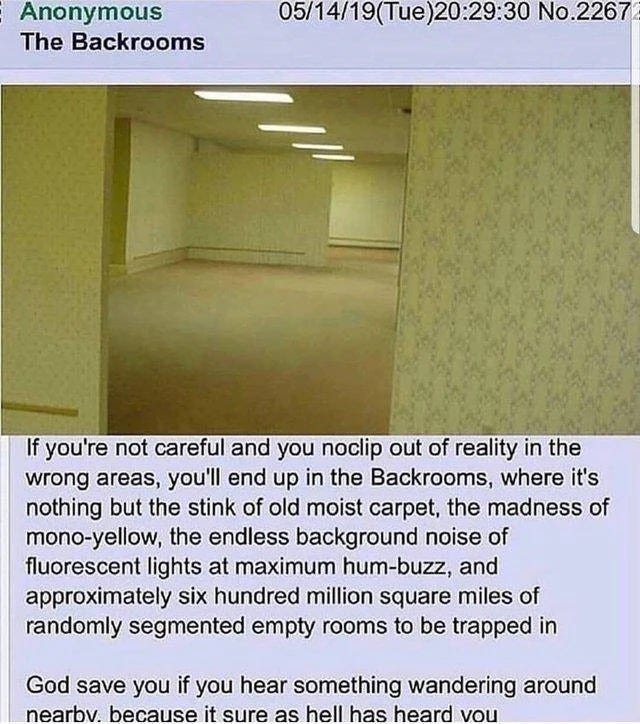
It became a ubiquitous creepypasta, a short horror story that gets recirculated online much like a copypasta (copying and pasting the same text, usually as a joke or troll). Creepypastas are the user-generated horror fiction genre of copypastas, except they’re not so much in-group jokes as they are internet folklore so often repeated as urban legends that they gain mythological status, as if they were real tales from the crypt. Their communal nature encourages others to expand on the stories’ lore, adding their own interpretations.
Other famous creepypastas include Slender Man, The Momo Challenge, Jeff the Killer, and Abandoned by Disney. The backrooms creepypasta capitalizes on our fears of an evocatively disturbing liminal space. This image, whose origins were long unknown, was later discovered by internet sleuths to be a photo taken during the renovation of a Hobbytown in Oshkosh, Wisconsin, circa 2003. According to public records, it used to be a furniture store called Rohner’s Furniture, dating back to the ‘70s.
Robert Mazza undertook the colossal reconstruction project in the early 2000s, aiming to convert the infamous backrooms section into a racing area for RC car enthusiasts called Revolution Raceway (a different section of the Hobbytown store). With much work to be done, it was an ambitious project, and Mazza’s friend Bill elected, for whatever reason, to document the renovations on his blog.
All of this lore was only discovered circa 2024, but Mazza has since retired and sold the store to another local hobbyist with a hobby store, now called John’s Hobbies. Its address is 807 Oregon St, Oshkosh, WI 54902, United States, and Google reviews show tourists venturing into the infamous backrooms site, looking to take photos and imagine what it’s like to noclip out of reality there. The new store owner is reportedly a good sport about it all, and indulges backrooms fans, allowing them to tour the store and giving them information about its history.


But back to the creepypasta.
People found this image—arguably patient zero of the liminal-spacesaesthetic—to be incredibly disturbing. Intuitively unnerving. There are the obvious reasons: the mustiness of the room with its putrid yellow, outdated wallpaper, bizarre overhead lighting like we’re in an office hellscape (Severance, by the way, drew heavy inspiration from the backrooms), and the incomprehensibility of the layout, with its random walls, the barrenness of it all, the lack of humanity.
The true terror, though, lies fittingly, in its liminality. The transientness of the space. How you can see that it is in the process of transforming. That on the one hand, its former structure has been abandoned and, like a caterpillar preparing to become a butterfly, is bracing to become something altogether different. It’s not so much the new thing that inspires the terror, nor what it used to be, but about that state of in-between, where you’re reminded of just how temporary it all is, that you’re confronted with things we’re trained all our lives to avoid: mortality, death, rebirth, erasure.
The creepypasta describes the possibility of noclipping out of reality, which is a concept that comes from video games. There’s a noclip cheat code that allows gamers to disable collision detection, eliminating physical boundaries between their character and solid barriers like walls, ceilings, and floors. Free to glide past physics to your heart’s content.
The user here morbidly fantasizes about noclipping out of reality itself into a sinister liminal space that’s since been dubbed “the backrooms,” where the essence of the place is altogether repugnantly familiar. Worse, it seems to go on forever. It certainly gives that illusion of claustrophobia, of endlessness. Like a game’s map glitched out and untethered from the developer’s constraints. Only, there are no other players. No objectives. No gameplay. Just space. Endless space. And yourself.
They then mention an entity that supposedly lurks in the halls, “God save you if you hear something wandering around nearby, because it certainly has heard you.” Simple. Short. Terrifying. Leaves much to our (disturbing) imagination.
Kane Parsons, a 16-year-old YouTuber with editing and Blender skills, decided to expand on the internet lore of the backrooms with his own artistic vision via his YouTube channel, Kane Pixels. Here, he began a long-running series that developed the backrooms universe with exceeding sophistication, world-building, and mystique.
His first upload, The Backrooms (Found Footage), was a 9-minute video uploaded in 2022. It depicts a found-footage-style filming aesthetic set in the 1990s, wherein a group of teenagers is in the middle of filming some sort of amateur indie project when the cameraman (or cameraboy) inexplicably noclips through the ground and finds himself thrust into the middle of the backrooms.
The bulk of the footage contains no dialogue, yet manages to build unbearable tension whilst developing exposition, and even capturing the aforementioned entities that lurk the halls. This entity, known as “The Lifeform” or “The Bacteria,” is only depicted briefly and with a minimalism that unnerves the viewer to the point of stomach churning every time the camera peeks around a bend. The cameraman spends the rest of the video running away from it as it chases him through the backrooms. It doesn’t end well.
The entity catches up to him, pushes him down a curious-looking threshold, causing him to noclip back into reality, falling out of the sky, to his death. Kane exercises impressive restraint in utilizing the entity throughout the series. Despite uploading 24 episodes, the lifeform reveals itself only sparingly. The majority of the footage revolves around lore and worldbuilding, and the natural tension that emanates from exploring the backrooms’ peculiar scale and incomprehensibility.
One 45-minute episode is mostly solitary walking and aesthetic, but the tension lies in never knowing when someone or something might appear. Turning corners, especially in the dark, or shimmying down crevices, feeling confined in claustrophobic spaces, or God forbid, hearing a noise, you’re reminded of what you could encounter.
The Backrooms community is an active, passionate fandom that dedicates itself to theories, documented lore, and easter eggs, tracking timelines, and recording down what they refer to as “Backlanguage,” a supposed foreign language spoken in the backrooms, complete with its own alphabet. There are mapped-out levels, numerous subreddits, and wikis, but they are not all canon in Parson’s series. Parsons has clarified that his series is just a specific interpretation of the backrooms, not connected to broader established lore.
This series develops an origin story for the backrooms, notably the Async Research Institute storyline, as well as its own vernacular. The series has coined certain terms like “the complex,” “hallways” (both of which are alternative terms for the backrooms), “lifeform,” “still life,” “null zones,” “threshold,” as well as specific tech and projects like the Low-Proximity Magnetic Distortion System and Project KV31. There are demarcated areas of the backrooms, a timeline following their creation and discovery, and notable characters like Peter Tench and Ivan Beck.
While I highly recommend both the original YouTube series and the recently released A24 film, both created by Parsons, I am not going to get into the weeds on these stories. The film looked great but lacked Parsons’ signature storytelling, which thrives in its native format, YouTube. This is likely owed to the fact that Parsons did not actually write the film’s screenplay and was instead written by a rather inexperienced screenwriter with a few minor credits in some TV episodes. Some of the episodes are incredibly short, some incredibly long. Some are highly analytical, others poetically esoteric. A personal favorite of mine is I Remember.
I want to talk about something bigger than the backrooms, but something the backrooms are downstream of. The essence of what made the backrooms so big, so ephemeral, so compelling to millions of people. Parsons’ YouTube series has 200 million views across its episodes. We’ve established the film is a smash hit, drawing crowds in droves in an era when cinema was rumored to be dying (did we sacrifice Timothée Chalamet for no reason?)
What’s notable is the demographic of its audience. While it’s undoubtedly found broad appeal, which can be attributed to Parsons’ instinct that the film adaptation should feel accessible to layman viewers uninitiated in the broader backrooms lore to avoid the dreaded risk of “lore bloat,” its core audience is unmistakably Zoomer.
This much was obvious to me in the palpably youthful crowd surrounding me in the theater. Apparently, my fellow zoomers are actually saving cinema, accounting for 87% of frequent cinemagoers, according to a 2025 Fandango survey. Backrooms, specifically, seem to appeal to the zoomer mind on a visceral level, while they are less resonant with older generations. It is appealing to all, but especially appealing to some. I don’t think that’s a coincidence
Liminal Spaces: What Does It All Mean?
This is a description of a book called The Scary Screen: Media Anxiety in The Ring, edited by Kristen Lacefield (who goes by Colonel Kurtz online):
“In 1991, the publication of Koji Suzuki‘s Ring, the first novel of a bestselling trilogy, inaugurated a tremendous outpouring of cultural production in Japan, Korea, and the United States. Just as the subject of the book is the deadly viral reproduction of a VHS tape, so, too, is the vast proliferation of text and cinematic productions suggestive of an airborne contagion with a life of its own.
Analyzing the extraordinary trans-cultural popularity of the Ring phenomenon, The Scary Screen locates much of its power in the ways in which the books and films astutely graft contemporary cultural preoccupations onto the generic elements of the ghost story, in particular, the Japanese ghost story. At the same time, the contributors demonstrate, these cultural concerns are themselves underwritten by a range of anxieties triggered by the advent of new communications and media technologies, perhaps most significantly, the shift from analog to digital.
Mimicking the phenomenon it seeks to understand, the collection’s power comes from its commitment to the full range of Ring-related output and its embrace of a wide variety of interpretive approaches, as the contributors chart the mutations of the Ring narrative from author to author, from medium to medium, and from Japan to Korea to the United States.”
I admittedly have not read this book (though it sounds really interesting),, but its thesis seems to be getting at something. It made me think about the ways our current technological anxieties might be emanating from modern, quintessentially zoomer, post-pandemic, natively online art … like liminal spaces.
It makes sense that zoomers would be especially affected by liminal spaces, considering they grew up under the most rapid technological shift in history (yes, I know every generation can say that at some point, lel). There are older zoomers, like me, who are so close to the millennial cut-off that I can distinctly remember a largely analog childhood filled with VHS tapes, visits to Blockbuster, and our third spaces being the local mall. I received my first iPhone in ninth grade.
The youngest Zoomers might have grown up as iPad kids (though not iPad babies) and grew up with their local malls getting demolished, instead opting for digital communities as their third space.
There’s a piece in The New Yorker published in April 2021, in the middle of the pandemic, which examined The Pleasant Head Trip of Liminal Spaces. It describes the explosion of the liminal spaces aesthetic from a niche indulgence to a mass morbid curiosity. Per Madelyne Xiao’s reporting, the subreddit r/liminalspace had exploded from just 500 members in March of 2020 to more than fifty thousand by mid-August.
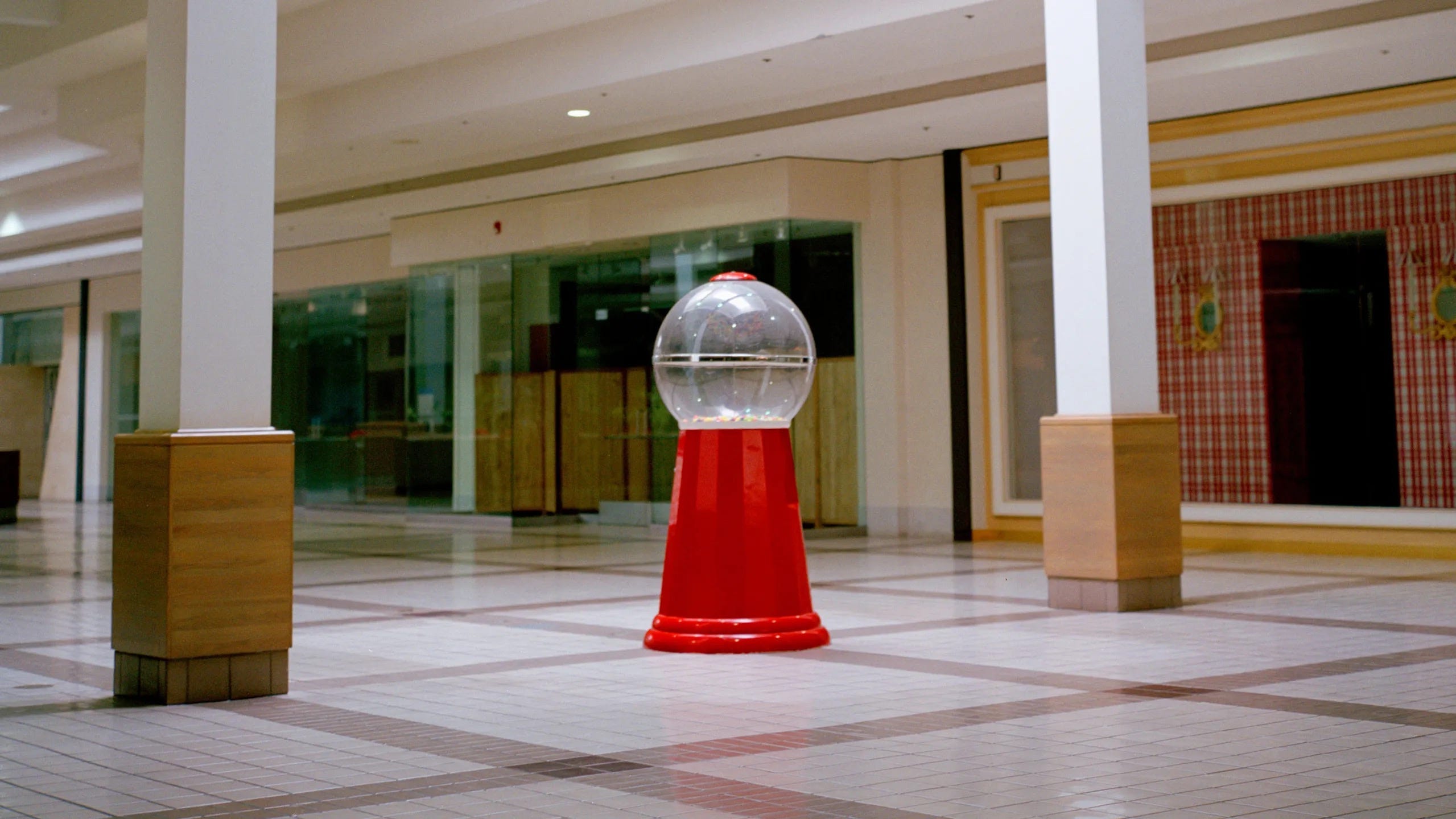
Interest multiplied exponentially during the pandemic, and today it boasts more than 1.1 million members. But why? Liminal spaces are eerie because they’re transitional. They’re typically photos taken of a place that’s used as a transition from point A to point B, like a hallway, an airport, a train station, or a waiting room.
As Xiao eloquently puts it, they are “in-between places that exist as means to an end, to be traveled through but not lingered in: stairwells, roads, corridors, hotels.” She says, “In forcing a confrontation with these prosaic architectures of passage, liminal-space images imbue the familiar with an eerie surreality. They owe much of their appeal to their framing and lack of human presence, which obliterate context and invite the viewer to populate the image with her own memories of comparable scenes.”
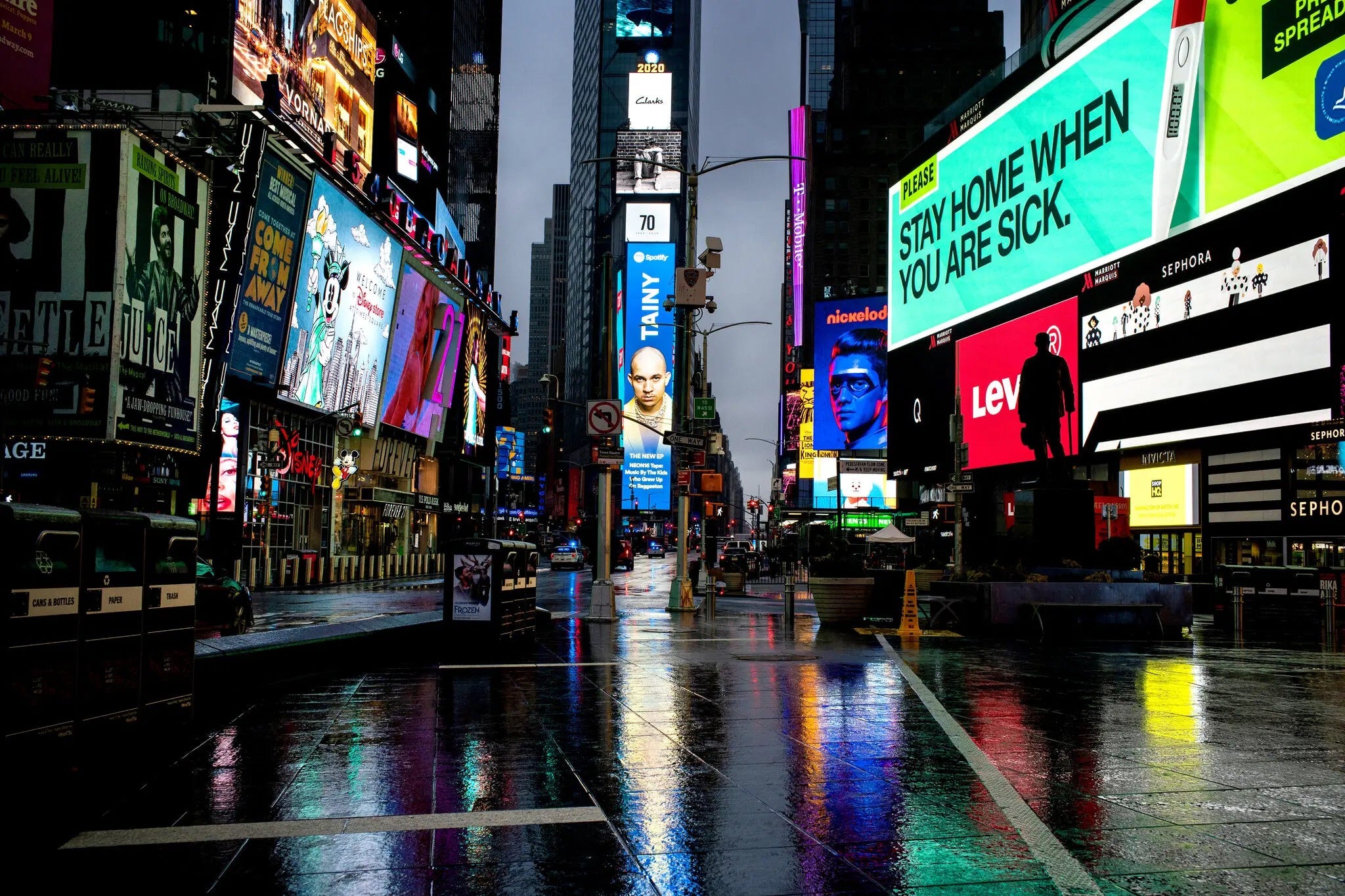
Zoomers were largely coming of age as teenagers in 2020, when the world shut down due to COVID lockdowns. It was like the entire world became one big liminal space. An empty parking lot. A shopping center devoid of any human presence. Entire cities frozen in time.
And while this was an experience not exclusive to anyone, what it deprived certain people of—pivotal life experiences—was particular to the youth, who were spending their last years of high school online, missing prom. For those transitioning to college, there were no on-campus festivities or house parties. While we were all being deprived of parties, gym workouts, church services, and leisurely strolls to the local shops, Zoomers were being deprived of rites of passage that don’t come around again. Here today, gone tomorrow.
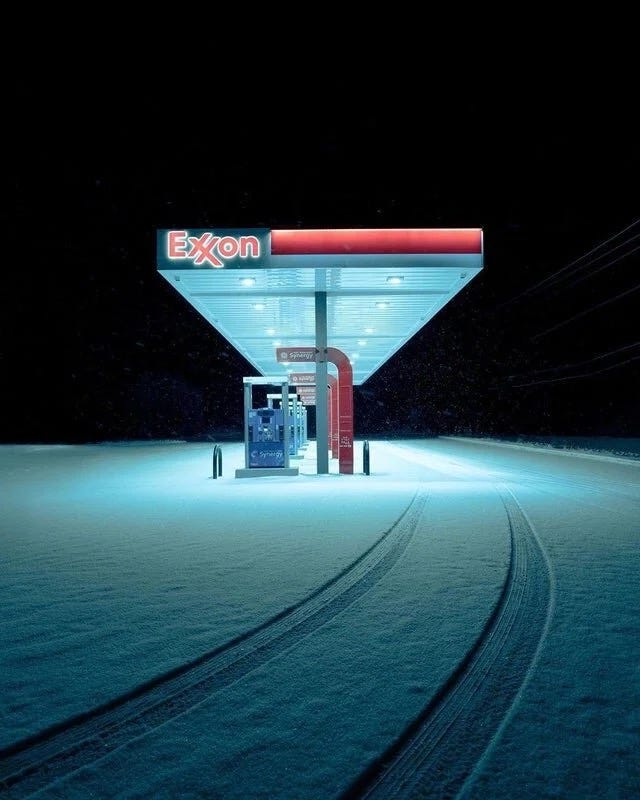
Now, we have a generation of young people who don’t drink or go to parties or have friends or relationships or really see the appeal of sex. They just kind of hang out in their house, play video games, or watch TikTok and do 70-step skincare routines so they never age, even though the sun never reaches their skin and there’s no one in their life to perceive them. For having not experienced them, they feel uninitiated into adulthood and instead indulge in perpetual adolescence (33-year-old women who are all “just a girl” and lost boys with Peter Pan syndrome).
This is, for those of you who are reddit-brained and already starting with the “well ackchyuallyy studies show that..,” it’s called hyperbole. As a geriatric zoomer, I get the z pass for these generalizations. The point is they’re spiritually true. The specifics are less important. Anyway, that’s not the point. This is not a “the kids are wasting away inside” article. At least, not exactly.
I want to get to the bottom of what is so resonant about liminality for us. I think it’s a perfect storm of transitional phases that have plagued Gen Z in particular, rendering transition itself spooky, terror-inducing, and dreadful. There are four overarching causes:
Online nostalgia culture runs on ‘90s and Y2K childhoods (liminal spaces often contain an element of nostalgia, with entire nostalgic offshoot aesthetics like Nostalgiacore). The liminality is childhood itself, but also the world you used to inhabit. One that was simpler, offline, wholesome, and safe. It is not always liminal, but sometimes it is. I think these aesthetics capture the embodied moment-to-moment presence of childhood, often consisting of images of slow living captured on low-quality cameras, while the transition to liminality within the nostalgiacore aesthetic represents the catharsis of it having been left behind.
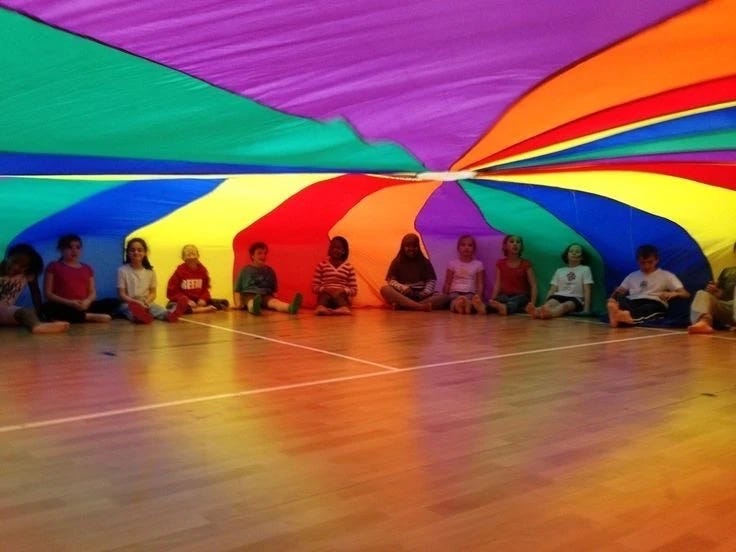
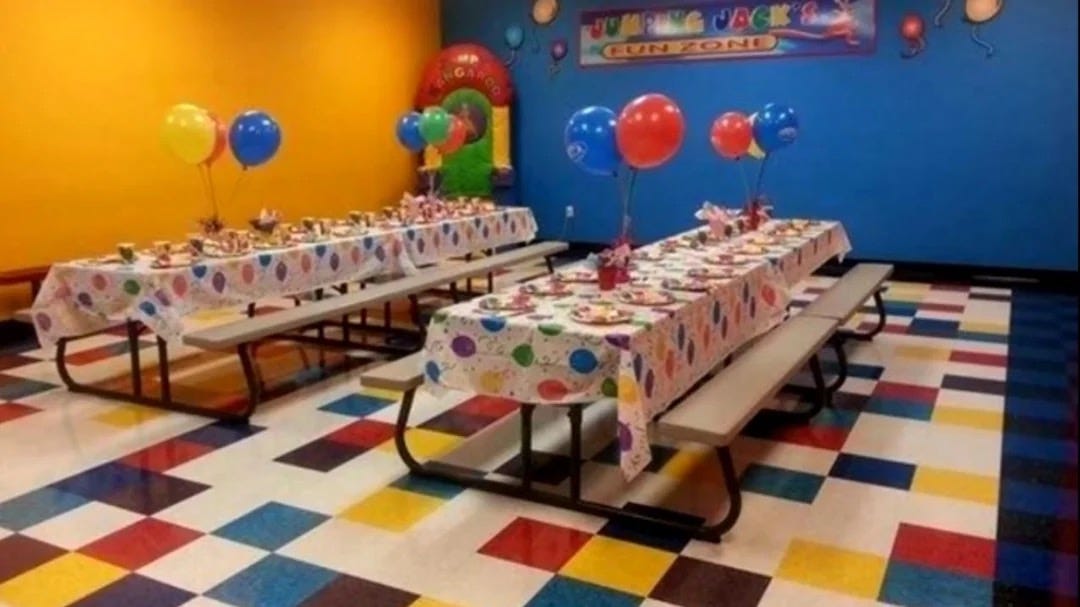
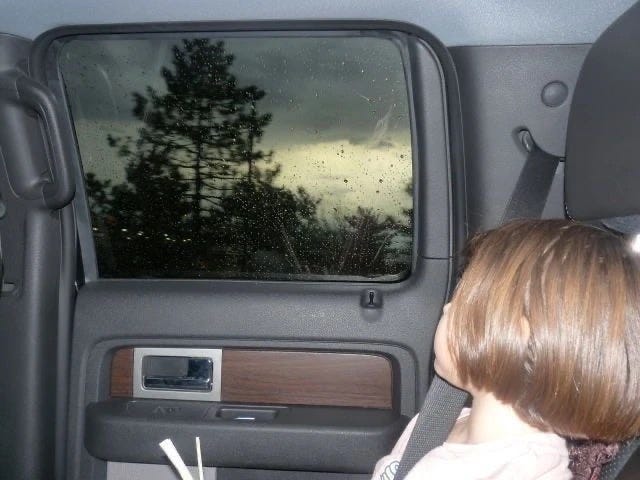
The shift from an offline childhood to a perpetually plugged-in world was incredibly abrupt and occurred while Zoomers were coming of age. This is represented by abandoned buildings, which were once sites of bustling community and liveliness. Businesses that represent an analog past and an unplugged childhood, where we had nothing better to do than share space with one another. Places here represent vestiges of the past, haunting the scenery (temporarily) until they become completely redundant, erased, replaced.
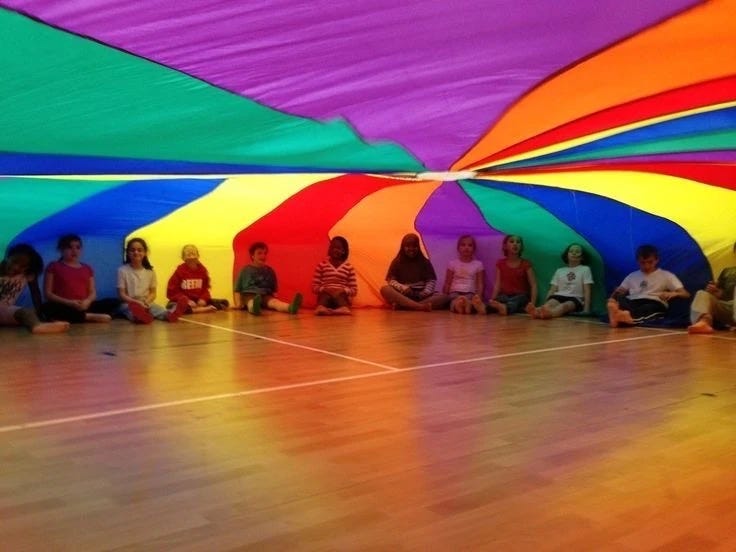
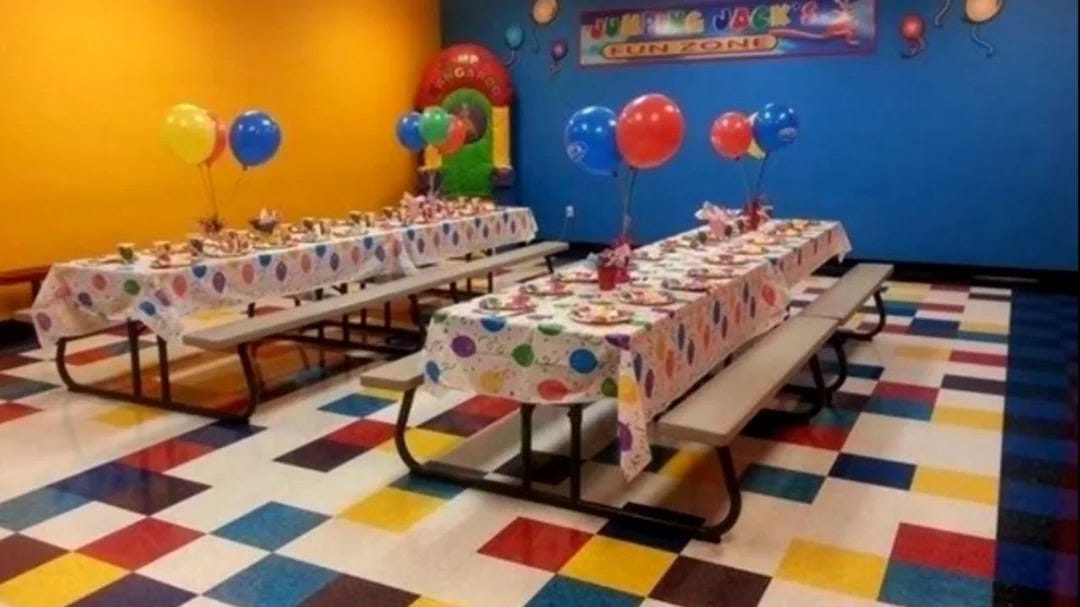
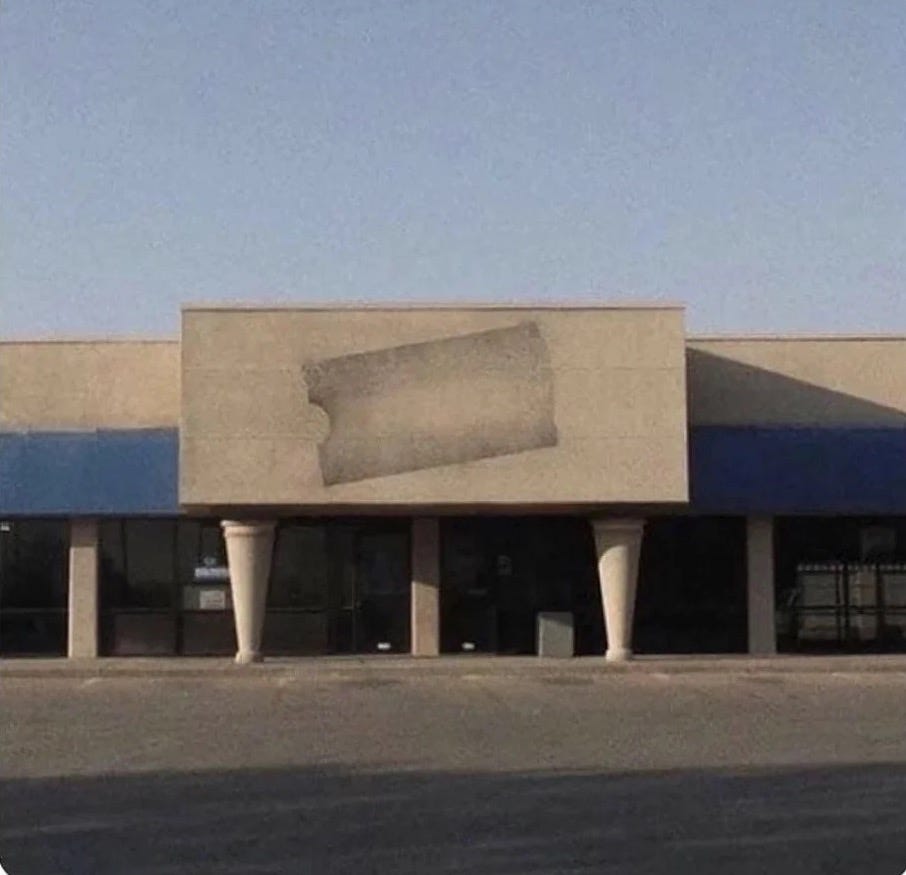
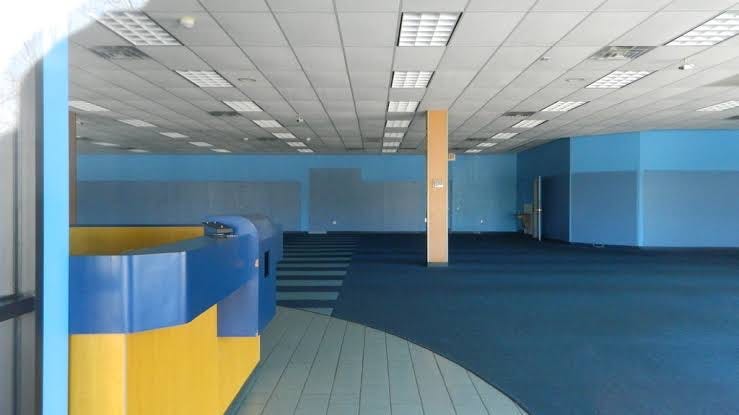
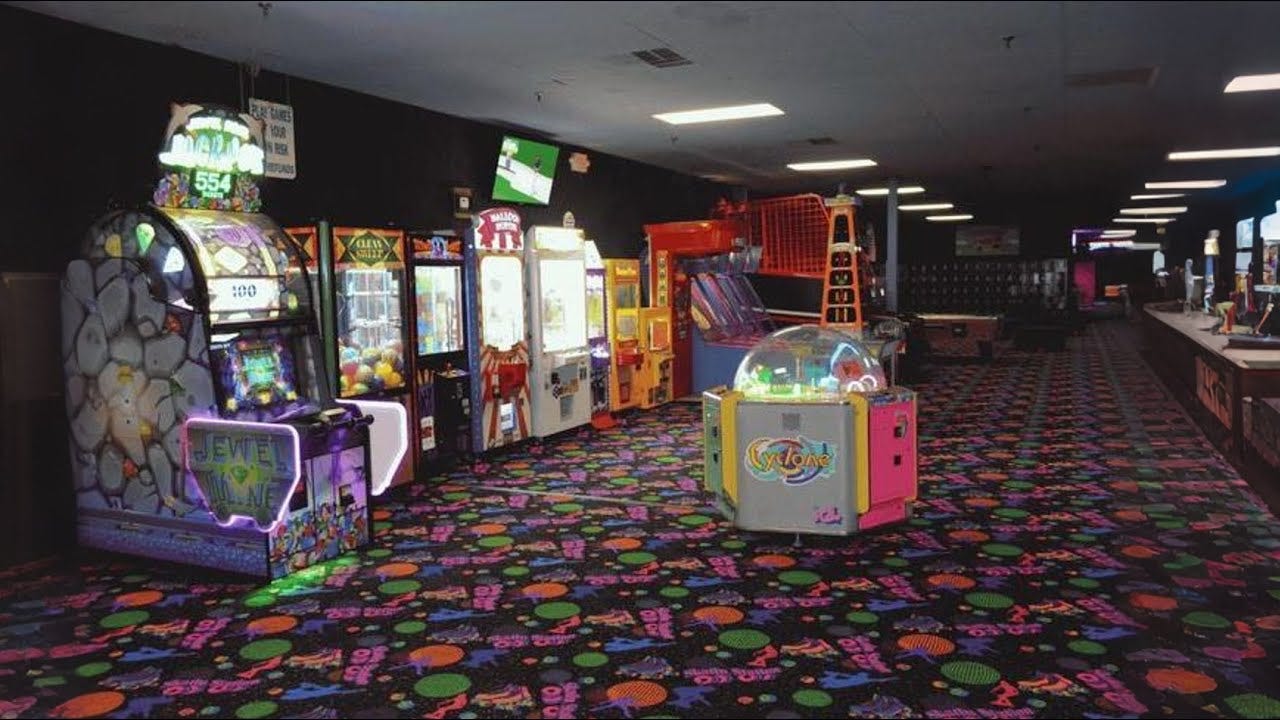
The pandemic transformed the world into a giant liminal space and robbed Zoomers of life’s rites of passage. 2020 rapidly advanced the life cycle of so many businesses and entire industries on life support. It pulled the plug on them entirely. Beloved local businesses shut down, never to return again. Lockdowns erased human footprints from communal spaces, providing them with an eerie surreality of post-humanity. Like we had been erased. For zoomers who missed out on pivotal life experiences, they would forever remain a curiosity, amounting to mythology rather than relatable experiences. Like a non-American gazing in awe at the yellow school bus upon a visit to the US, the ordinary can become mystical so long as it’s mythologized, unfamiliar, and out of reach.
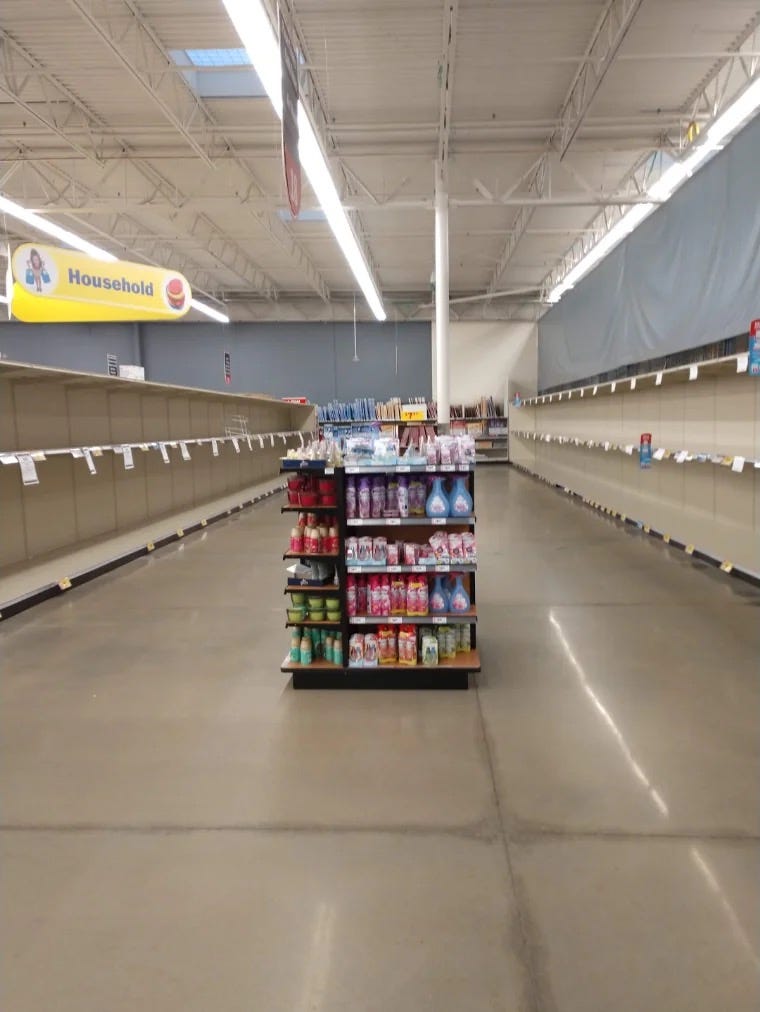
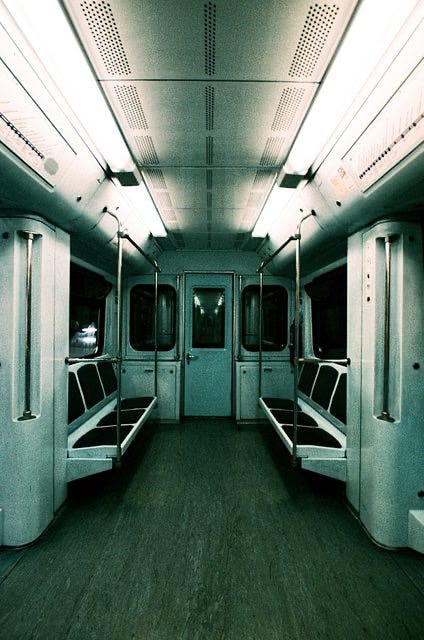
AI (and the consequences of the smartphone and infinite scroll) is playing on our tech-related existential anxieties in a way similar to how the shift from analog to digital manifested in early-2000s media like The Ring, wherein the horror lies in the medium itself. The liminal spaces aesthetic has emerged as a meta-commentary on our anxiety about the uncertainty of the future. It plays on fears of rapid change, displacement, being left behind, and the unknown, while clinging to suspension, nostalgia, and the pause of time.
Full Circle Liminality: The Only Way Out is Through
The term “liminality” was first coined in the twentieth century by Arnold van Gennep, where it was used to describe the quality of ambiguity or disorientation that occurs in the middle stage of a rite of passage, when participants no longer occupy their pre-liminal status but don’t yet hold the status they will hold once the rite is complete. The liminal state, which is pre-transformation, but post-separation, he called standing at the “threshold” (which is, funnily enough, another name for the backrooms).
In this case, the threshold is being caught between two identities and the various ways your life is oriented around them. Gennep identified a universal pattern of rites of passage across cultures. They follow three general stages: separation, liminal state, and assimilation, or preliminal, liminal, and post-liminal.
Taking the transformation from child to adult, for example, the process of separation is separating from your family and the “death” of the child, so to speak. The liminal state of puberty involves passing a “test” to prove you are ready for adulthood. The third state, if you have passed, is reincorporation, involving the celebration of a “new birth” of the adult and welcoming them back into society, where stability returns and the person has a new set of obligations.
He also identified four categories of rites that emerged across cultures and societies: passage of people from one status to another (involving initiation ceremonies), from one place to another, from one situation to another, and the passage of time.
Cultural anthropologist Victor Turner expanded on this theory, focusing on the societal experience of liminality. Turner observed that liminal states are periods of ambiguity and disorientation in which ordinary social categories/hierarchies break down. He called the experience of being in a liminal state “betwixt and between.” You’re not who you were, but not yet who you will become.
He also identified a phenomenon he called “communitas,” which is an intense feeling of equality and shared humanity with others that emerges when ordinary hierarchies are (temporarily) dissolved. In liminal phases, people may relate to one another less through social status and clearly defined roles and more through a shared experience of transition. Ex: college freshmen arriving at college, military recruits in basic training, the constituents of a place that just faced a natural disaster, America post-9/11, and pilgrims on a religious journey.
Liminal spaces aptly capture, for young people, this threshold of identity and understanding of the world, where we know the old institutions, community centers, and pre-digital world no longer exist, but we’re also being deprived of traditional rites of passage that delineate transformation, leaving us feeling psychologically suspended. We feel communitas with one another because we’ve come of age in the same transformative era, where life feels like a haze of embodied childish reality and consummation by the digital machine that hasn’t once let go of its vice grip since. The backrooms and liminal spaces communicate this language through art.
The most interesting part of Turner’s theory to me is his conception of the powers of the weak: “the unique, often subversive influence held by marginalized individuals who exist outside of formal, hierarchical societal structures.” What I like about Turner is that he firmly believed in a dialectical process—an ebb and flow to society that naturally relies on a balance of order and chaos, tradition and progress, equality and inequality, and so on.
He argued that during periods of liminality, the powers of the weak gather extra salience and authority in the form of truth-telling, moral authority, and cultural creativity. Historically, this was the function of the court jester, who paradoxically had an outsized sense of power (in some sense) even compared to the king, being uniquely positioned to say things no one else could.
Culturally, it feels like with the fall of institutions, we’ve seen the rise of cultural court jesters in the form of YouTube essayists, internet provocateurs, wacky livestreamers, and ragebaiting OF creators. We also see the rise of podcasts where anti-establishment figures promise to tell forbidden truths. We have abandoned orthodoxy and all its errors for a freak show.
However, Turner suggests there is a bigger logic to this whole circus that results in an eventual balancing act. A much-needed correction, where the court jesters, foolish and ridiculous as they may be, expose the rot at the heart of the system in a salient enough way to prompt much-needed reform and reorganization.
The Backrooms, meanwhile, was popularized by anonymous users on 4chan and teenage YouTubers who created niche horror cinema entirely outside of the system and managed to get the attention of the system itself—studio A24—resulting in one of the biggest films in modern horror. There’s something poetic there.
More Esoteric Liminal Spaces Aesthetics
Weirdcore is where things get really, uh, weird. This surreal internet aesthetic highlights low-quality photography or distorted images combined with low-resolution graphics, floating text, and an uncanny mish-mash of art and ideas that create a sense of oddity, dread, alienation, anemoia (nostalgia for a time or place you never experienced), and anxiety.
The intent is to make the viewer uncomfortable—like something is amiss, often featuring meta-commentary that plays on fears or yearning for a time long past that you can’t go back to, or this sense you’ve stumbled upon something you shouldn’t have. Like you are out of place and don’t belong here. You might see ominous text such as “there is nothing wrong here” or “a truth I’ll have to accept at some point” superimposed on a liminal space, such as an empty kitchen.
The out-of-context text, combined with hyper-specific locations that feel as if the people have been removed from them, creates a sense of derealization or foreboding—a longing to return to a simpler time. It’s a type of surrealist anti-art in line with the Dadaist movement, but for the internet age.
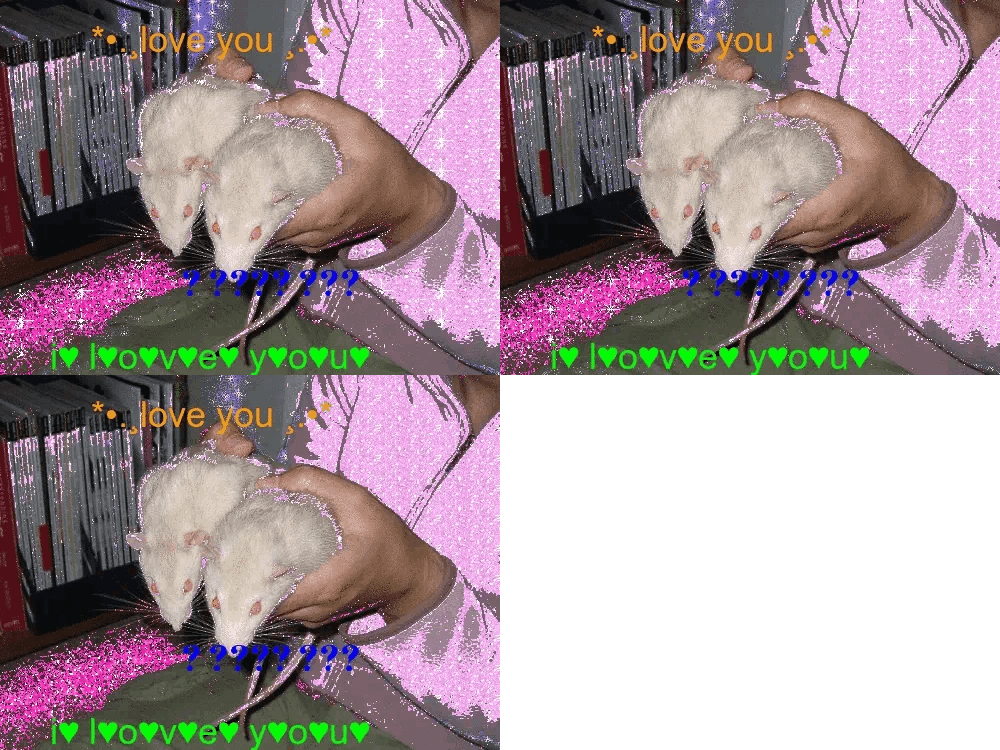
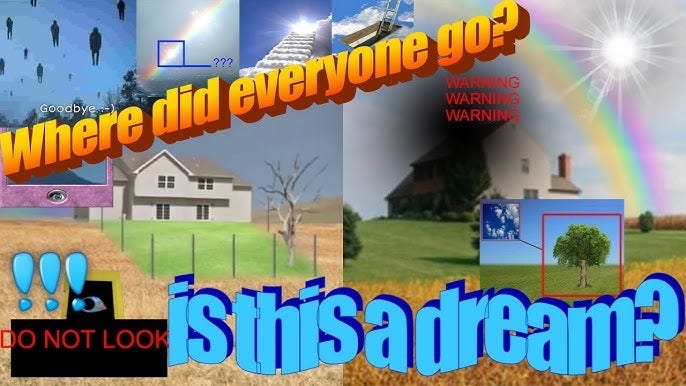
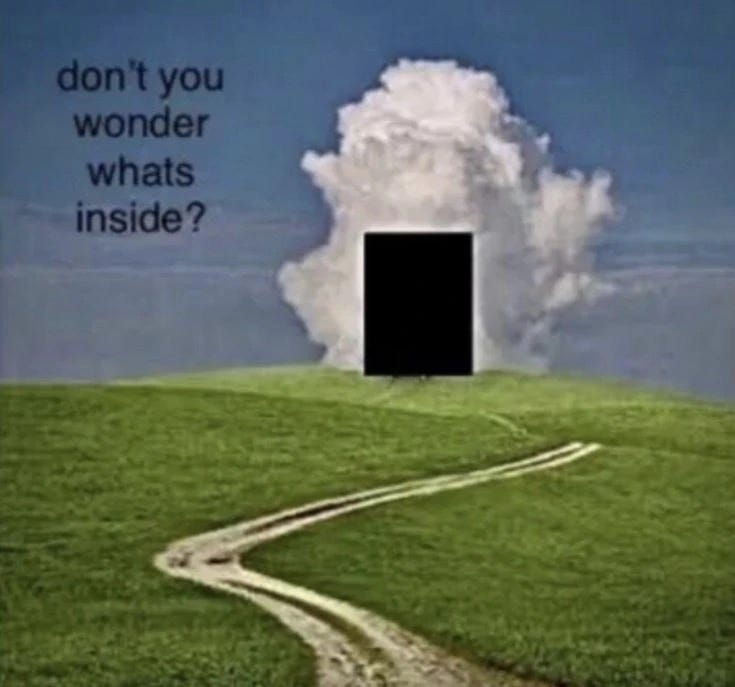
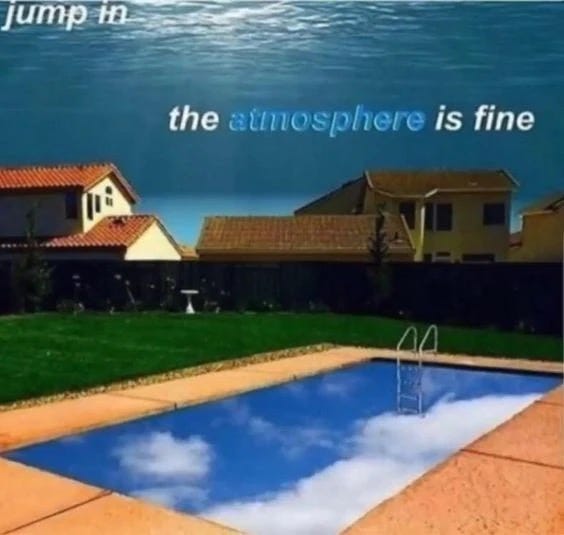
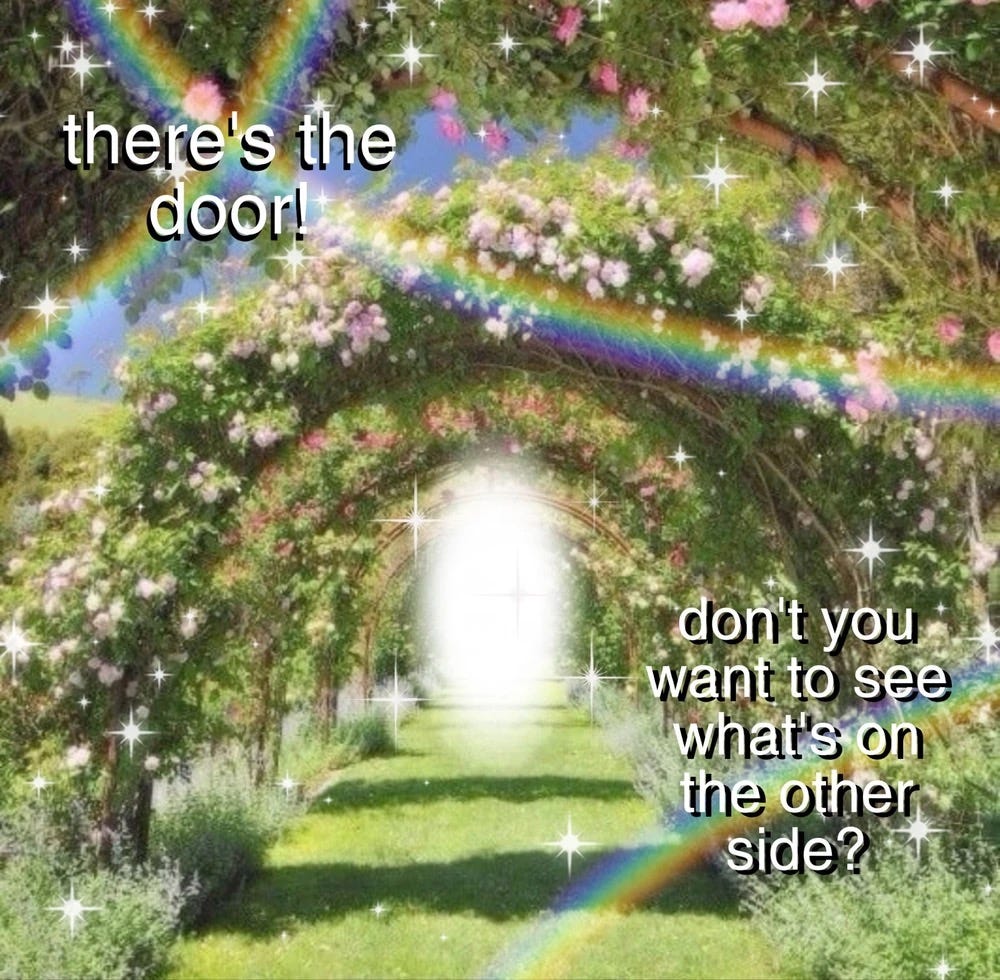
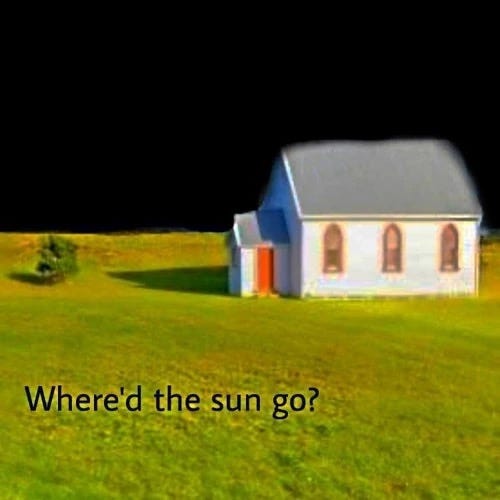
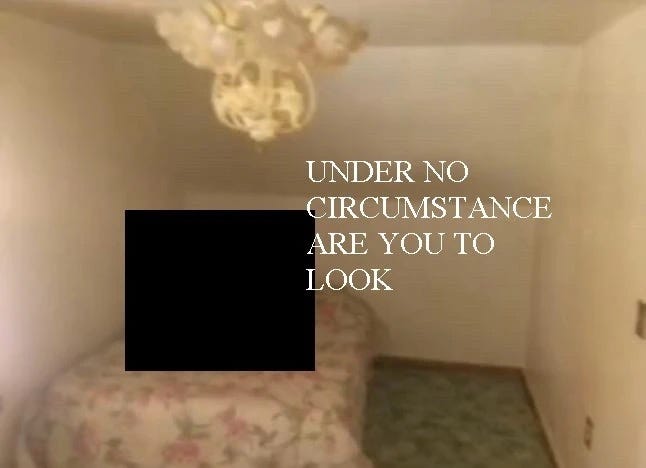
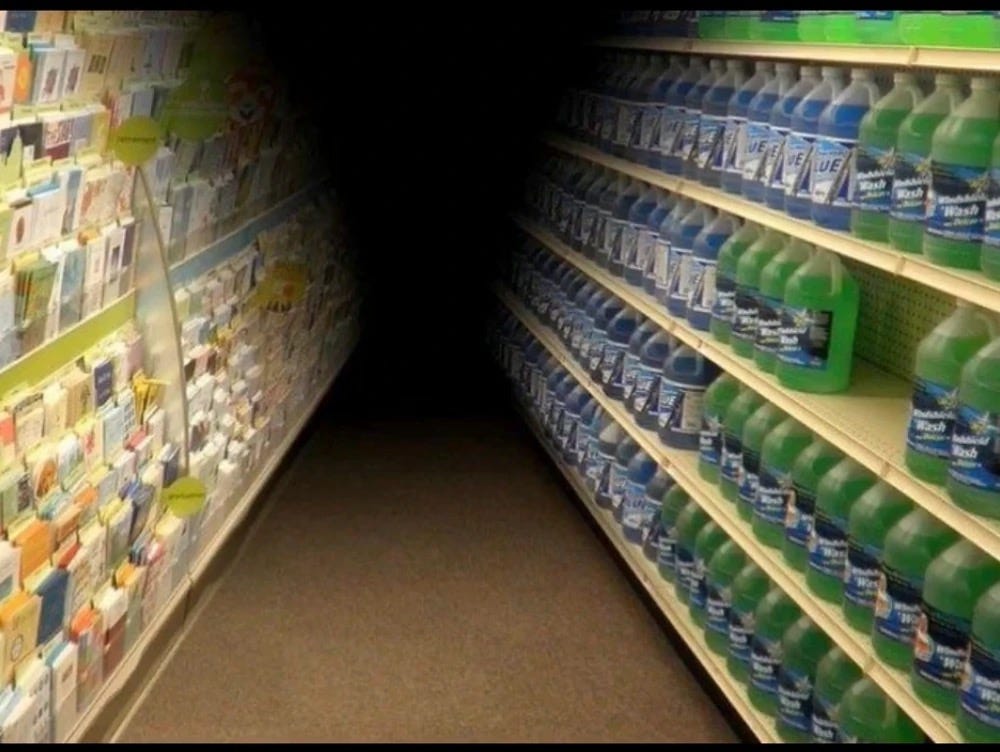
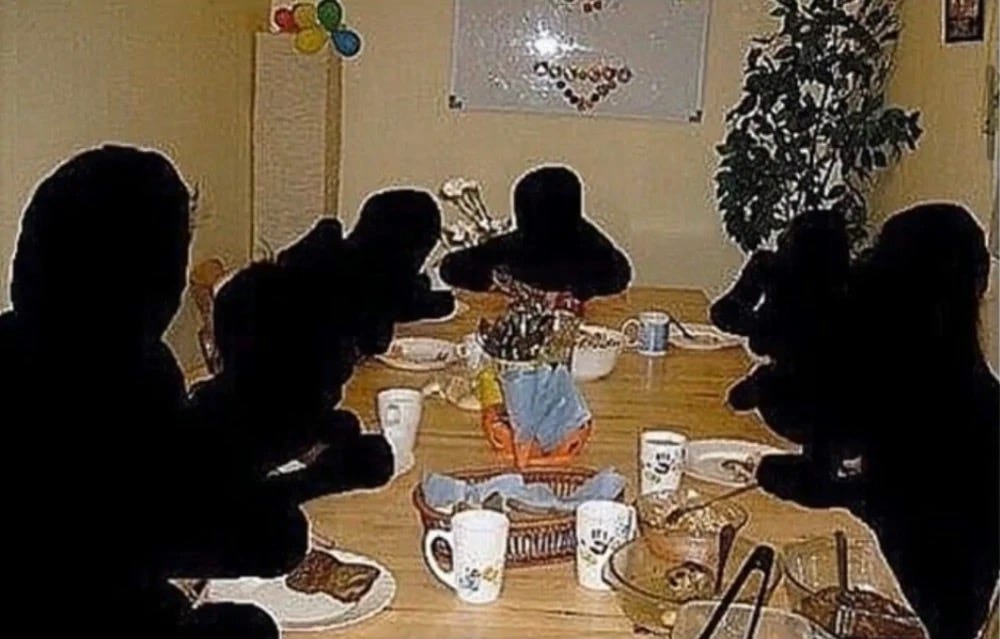
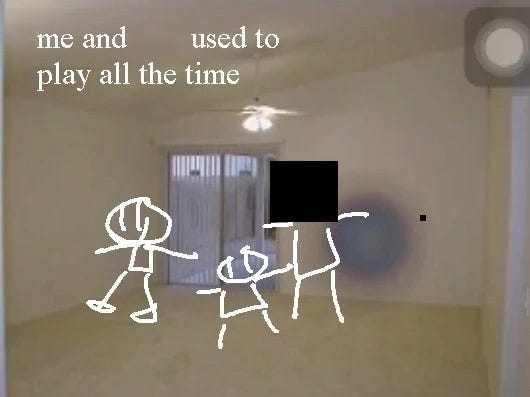

Do you feel that? That sense of foreboding? The warning that you’ve taken a wrong turn? The implication that something is very, very wrong? Well, I’m sure it’s nothing lol!!! (It is definitely, societally, something.)
Weirdcore tends to include visual elements like voids and a mood of unease, dread, regret, or even trauma. I think it’s communicating to the viewer, “you’re on a one-way trip to who even knows, but I don’t think where we’re going is anywhere good, God help us all.” Its purpose seems to be to wake the viewer up.
Dreamcore, the optimistic cousin of weirdcore, likewise embraces surrealist imagery but is less harsh and more comforting in a whimsical dreamlike sense. It plays with safer, more comfortable themes like pastels, clouds, playgrounds, nostalgia, biblical angels, and peering eyes. In Dreamcore, liminal spaces fall to the background, while dreamy, surrealist imagery is overlaid. They include themes of questioning reality and identity, as well as comforting yet melancholic nostalgia.
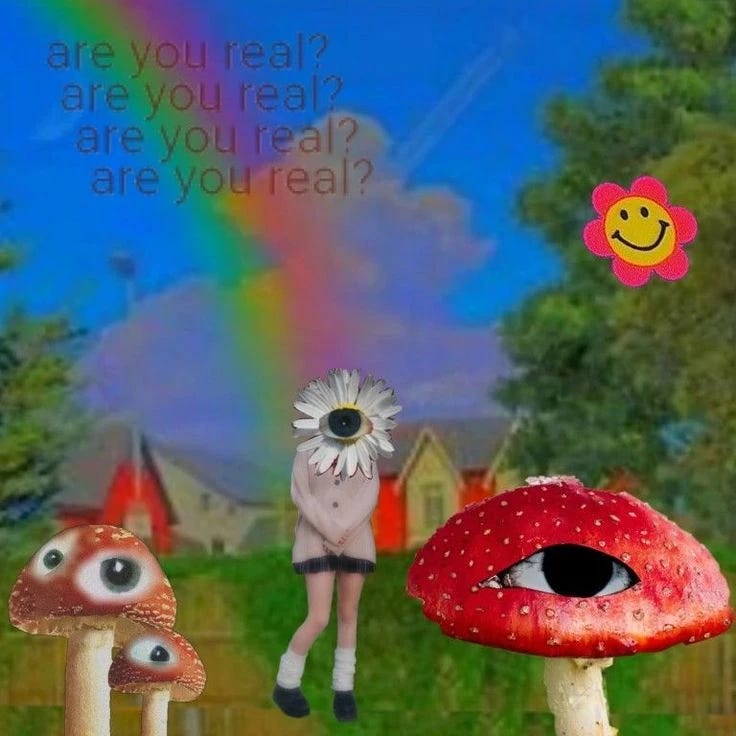
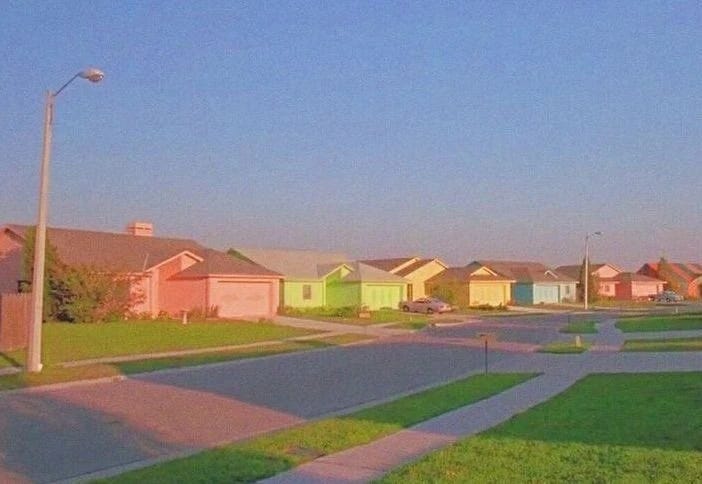
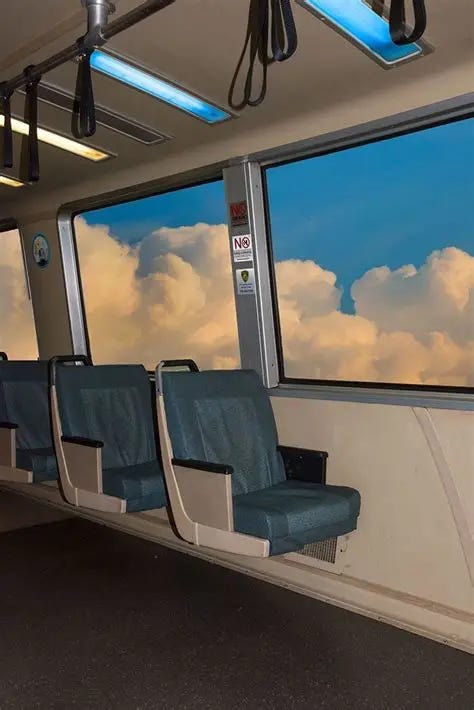
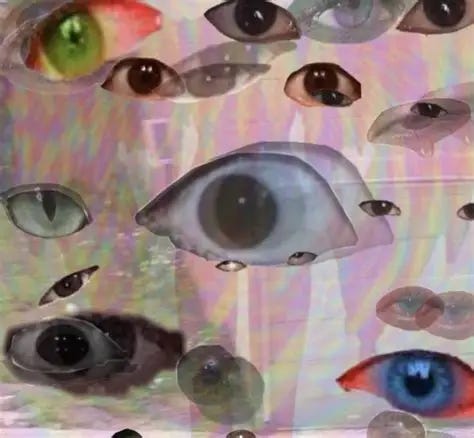
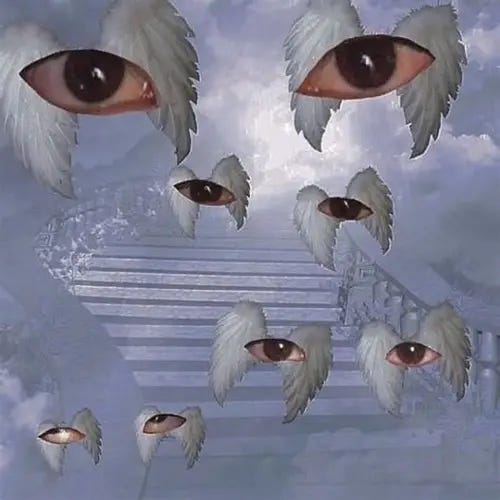
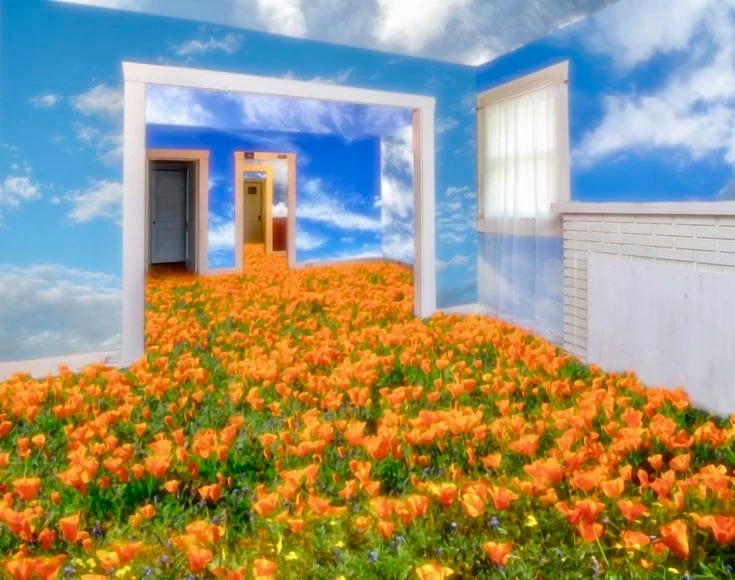
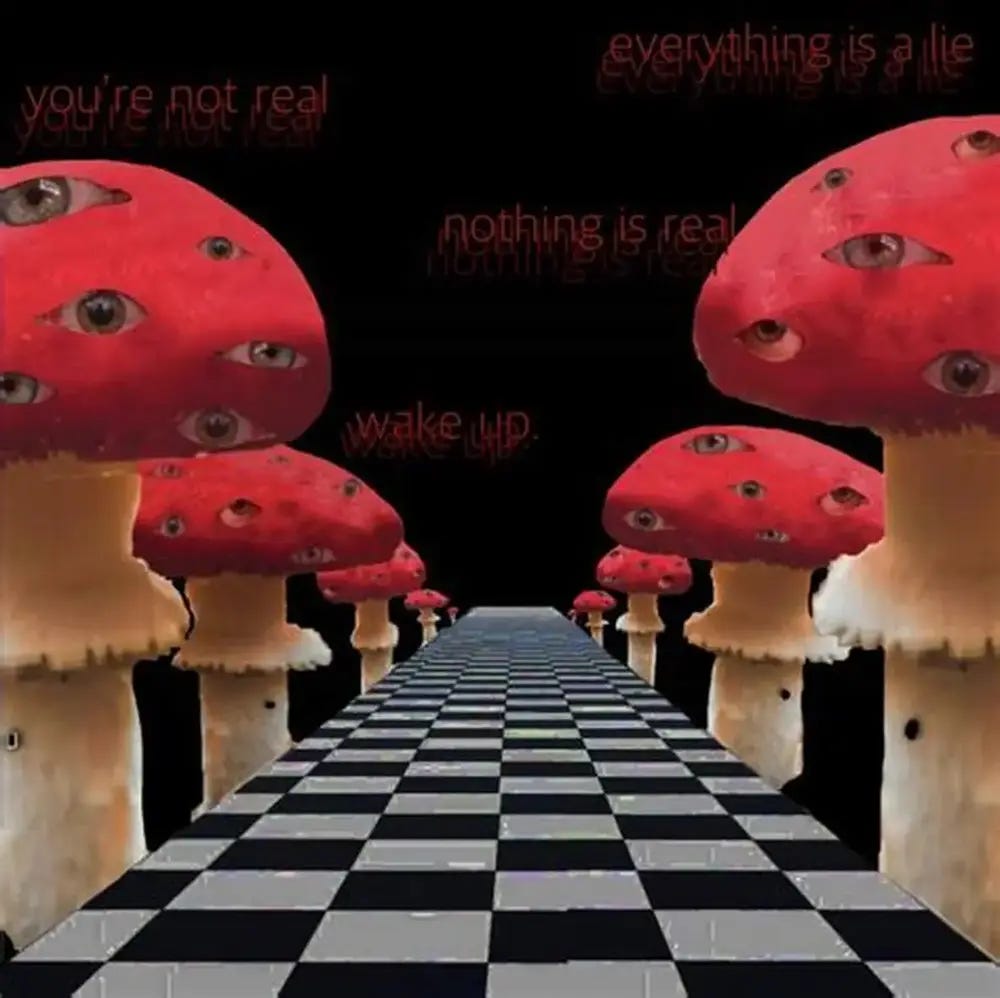
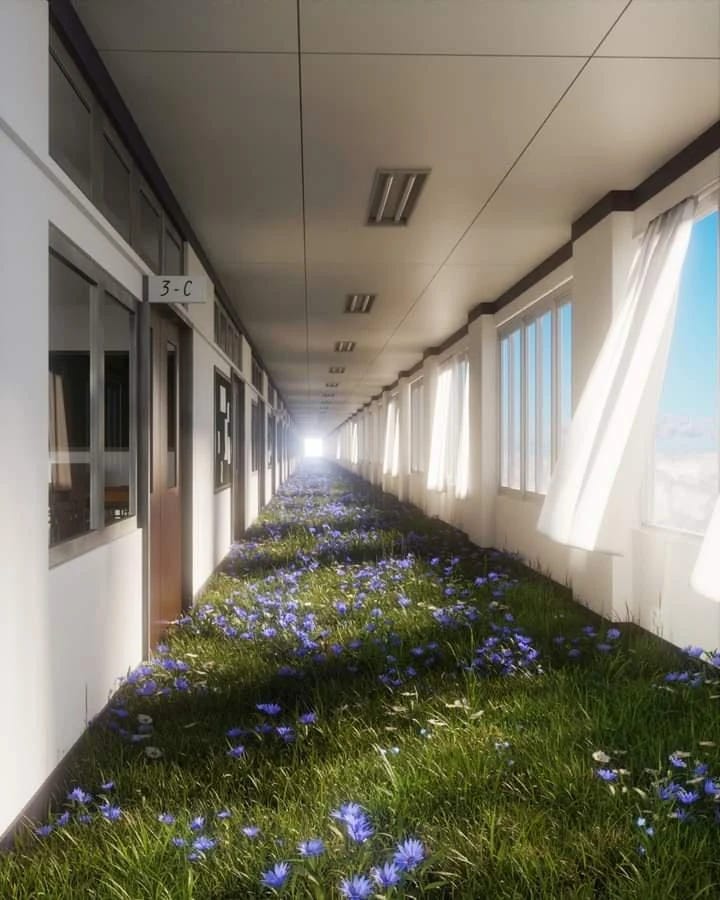
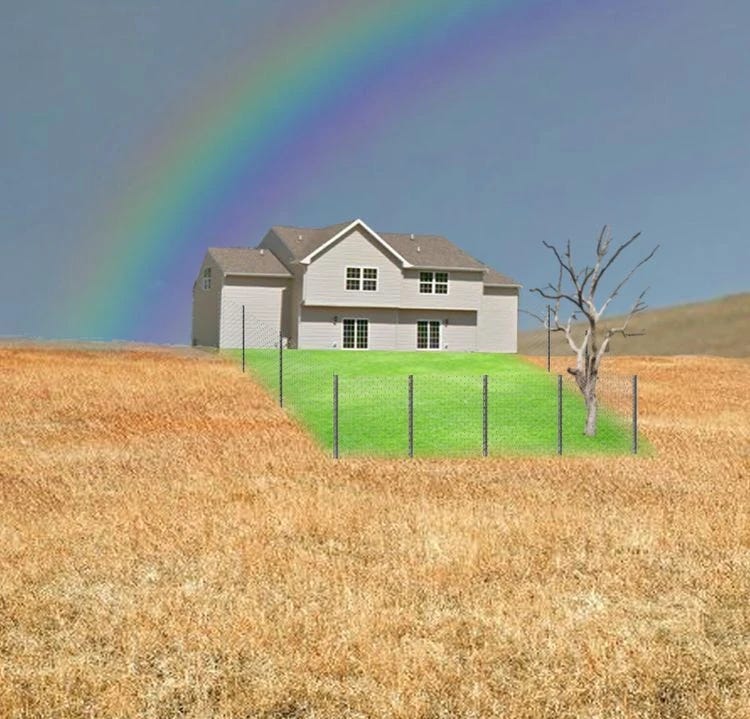
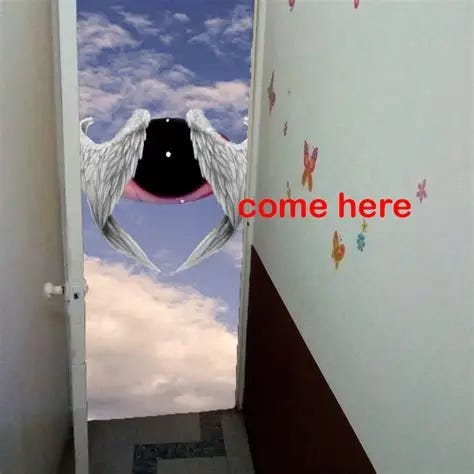
Do you feel somewhat comforted and safe, but also validated in recognizing the uncanniness all around you? In knowing something is off, but having some sort of guide or safe place that allows you to sit in some sanctuary far away from the madness? That’s what I think dreamcore is getting at.
If these aesthetics were philosophies, weirdcore is closer to true nihilism, whereas dreamcore is closer to … optimistic nihilism or absurdism.
Liminal spaces as an aesthetic tends to focus entirely on a transitional or usually populated space frozen in time, completely empty, and often evoking a sense of familiarity, especially when familiar places are used as a means of time capsule art, like a famous business that no longer exists but whose branding leaves familiar marks. Liminal spaces speak to philosophical warnings of nostalgia and its limitations: “You can go back to the past (visit it in your memories, catch glimpses of it in photos or old videos), but no one will be there.”
If liminal spaces are about contending with change—that feeling of being stuck between worlds—then dreamcore and weirdcore are a means of making peace with the fact that change is already here. The past is already gone. They often feel whimsical, hazy, like a feverdream. All three are appealing to a sense of the uncanny valley, but the former two often feature meta-commentary (such as text like “why do I even exist” or on certain worries and longing for a different time or place).
This is probably an expression of how Zoomers’ childhoods exist as fragmented digital memory. Memories are not so much consolidated in photo albums, a few videotapes, and stories that your mom tells over and over with sustained glee as they are scattered across devices, dead social media accounts, shutdown websites, and flash games. Things that existed in a flash and were gone just as fast. It’s like we live in the archive (hopefully you at least have an archive).
We had more means of documenting our childhoods (for better or worse), but the abundance of options—the rapid pace of technological advancement, shifting between new social media platforms and devices—made that documentation and the experience of it in the moment chaotic and scattered. Lacking simplicity and a neat chronological timeline that can be recalled with ease.
Because many of these memories were made in this weird alternate plane of digital existence (whether you were playing Clubpenguin, IMVU, or Webkinz, or Gaia online, or messaging your friends on AIM or organizing your top 5 friends on MySpace at an age that should inspire shame), they have a bizarre quality of bending time and space. It’s no wonder we need such esoteric art mediums to make sense of them.
Looking back, it’s like, where was I for long stretches of time? In some weird online rabbit hole? Attending “screening parties” of Degrassi on The-N dot com? (Please tell me someone remembers these.) Personally, I wasn’t just “hanging out,” I discovered who I was through these mediums. Not just superficially, like trying on different aesthetics or experimenting with different niches. No, I’m talking about fully identifying who I was and what I believed on a philosophical level, and making every effort to organize my entire life around that digitally, until it encroached so deeply into my real life that there might as well be no distinction between the two.
I mourn the wild-west internet I grew up on. My childhood memories of the internet are all tinged with euphoria. I distinctly remember viewing the computer through my starry-eyed child’s eyes as a sort of transcendental space where pain and reality dissipated, where noise and even feeling ceased to be.
It was anti-embodiment, which might be harmful in its own right, in its capacity to hypnotize one into a trance of detachment from self and engulfment in unreality. But that unreality was once so wonderfully exciting, organic, and hopeful. Most enticing was its newness as a world or as a realm distinct from the material one. Where ideas and people, or at least the idea of a person, lie in this digital container, waiting to be tapped into, discovered, interacted with.
My earliest memory of ~the computer~ is when I must have been about four years old, in my first childhood home. We had a basement that served as a living room hangout. It’s also where we kept the computer when it was a clunky old thing that demanded you carve out space for it, rather than it carve out space from you. This would have been around 2001.
I was young, so there wasn’t much for me to do on it, yet, and just as the internet was young, there wasn’t much to discover. But even then, I could glimpse into the computer’s future capacity for creation, opportunity, and play. It violently emanated, for reasons even now unbeknownst to me, raw potential.
Maybe it was because I always had an overwhelming desire to get out of my head, but from a young age, the computer was so much more than a device or the mere machine that had MS Paint on it or GirlsGoGames or ClubPenguin (where my first penguin boyfriend cheated on me by taking other bitches to his igloo). It was transcendence. A dream world. It was, as Katherine Dee has so eloquently articulated for The New York Times, something of a “portal to the otherworld.”
It filled my every natural desire. I never regretted for a moment all the times I traded real-world experience for longer screentime on my precious ‘puter. And it never really lost its luster for me. After all, I met my partner online, met most of my current friends on here, and my entire career has revolved very specifically around online culture. It is a job made possible only by the internet. By being on it too much.
Liminal Spaces as Incidental Commentary on AI Slop and Human Displacement
The Backrooms film itself plays with commentary on AI slop, even if only incidentally. That is, Parsons has been outspoken about his objection to AI having any place in the creative process, and he seems to see how the film’s elements easily map onto that ethos. However, he’s careful not to be too on-the-nose about it, telling an interviewer he doesn’t like to get too topical on the last few years:
“I wouldn’t ever say this film is supposed to be about generative AI and the over-reliance on neural network prospects, but I think those are all symptoms of a broader trend towards the infinite need to refine and solve and be curious about things to a degree that is going to result in a sort of system that outsources our everything. It’s a constant series of refinement with no end in sight, and I think that you’re doing that to experience and reality itself, and so at some point, you get something like the backrooms.”
“It’s like it’s wearing the skin of the past, like a simple past that was real and was touchable, and I think that’s probably why it’s worked so well for people. A lot of these photos harken to like a sort of early 2000s or 90s sort of childhood, and a lot of that feels like it’s the last sort of, and maybe this isn’t even true to begin with, but culturally it feels like a sort of last hurrah before this gray veil touches over everything in beginning of the 2000s and it feels like there’s an earnest attempt at actually feeling alive for a moment and it’s like now this thing that is infinite and forever is kind of trying to wear the costume of a still-functional species that is connected. You know, I think it’s that.”
Acting as a labyrinth with no escape (well, actually, you can escape as there are genuine entries and exits, though the rooms reorient you and you can loop through space (and in the YouTube series, time). The Still Lifes are versions of real people that get corroded by the backrooms’ remembering” them. As time goes on, the copies of the memory become further degraded; likewise, with the structure itself, misremembering layouts and furniture. Everything is slightly “off.”
‘When you think about it, the Backrooms are basically like generative AI. Recreating environments based on what it’s seen, with no idea what any of it actually means,” someone commented on Parsons’ YouTube channel. As they repeatedly say in the film, “It’s like trying to describe a dog to someone who has never seen one and then asking them to draw it.”
This is, of course, reminiscent of prompting an AI to generate an image of something or someone, with each new prompt to refine the image or create a new copy, becoming a bastardization of the original. It has the components, but they’re all wrong, the way they fit together—the proportions, the size, the focus, the number of limbs—is colossally confused. Bizarrely, the signature yellow tint of the backrooms also resembles the inexplicable yellowing of AI images.
But it works as a metaphor for a lot of things, including the direction they chose to go with for the film: how our own memories functionally degrade and become corroded copies, which bastardize the original memory each time it is recalled.
In the backrooms, things aren’t what they’re supposed to be. Dimensions and scale are off. Rooms are infinite and constantly expanding or rearranging. Every day, innocuous inanimate objects and home fixtures suddenly take on a sinister quality because they’re removed from their typical context, inappropriately jutting out of walls, sinking into the floor, or grossly proportioned in a way that evokes dread. There are an ominous number of lights, doorways, and hallways coming out the ass, like an architect constructed it on meth.
It’s quintessentially ‘90s in aesthetic, between the yellow-stained walls that feel like an abandoned warehouse and the old-fashioned furniture. All furniture, no people. Ironic, as furniture is meant to be sat on, lived in. Here, it is not even ornamental; it is sinking into the ground, protruding from the walls like an abomination. Or a forgotten memory, only just barely surfacing from the floor of the psyche.
Parsons is able to create a sense of foreboding from singular objects, such as a couch in a gigantic room. No people, no other objects, or interior decorating. Just a couch. It evokes nonsensical impracticality and an implicitly sinister sense of inhumanity.
One shot that stood out to me from the film was these three giant, unrealistically sized chairs all squished together, facing one another, to the point of touching. As a commenter pointed out, they were “slightly misshapen, proportions just wrong, tall but squished with really short seats/armrests…just feels a little spooky.” The devil is in the details.
When Parsons says he’s not setting out to make anti-AI art, I believe him, but I also believe the anti-AI sentiments leak out by virtue of those ideas lingering not just in his own unconscious, but in our collective unconscious. This new technology adds another societal anxiety and, therefore, another layer to interpret the inexplicable pull of liminal spaces and the art they produce.
Liminal Longing From My Childhood: Local Roller Rink and Mall Announced Dead, Killed in Cold Blood
Obviously, the inherent liminality of transitioning from childhood to adulthood is not exclusive to Gen Z. We have, believe it or not, all been children once. What is unique is the fundamental transformation of the world that accompanied this transition. Zoomers (and millennials) are mourning the world they grew up in and the future they were promised.
90s and early 2000s aesthetics were incredibly futuristic. Optimistically futuristic. It was hard to imagine, at the turn of the millennium, that there could be any technological advancement that wouldn’t bring about total human flourishing. It was baked into the 90s futurism/Y2K aesthetic with its flashy chrome, reflective surfaces, robo-imagery, and transparent tech designs, which felt like we were getting cyborg widdit.

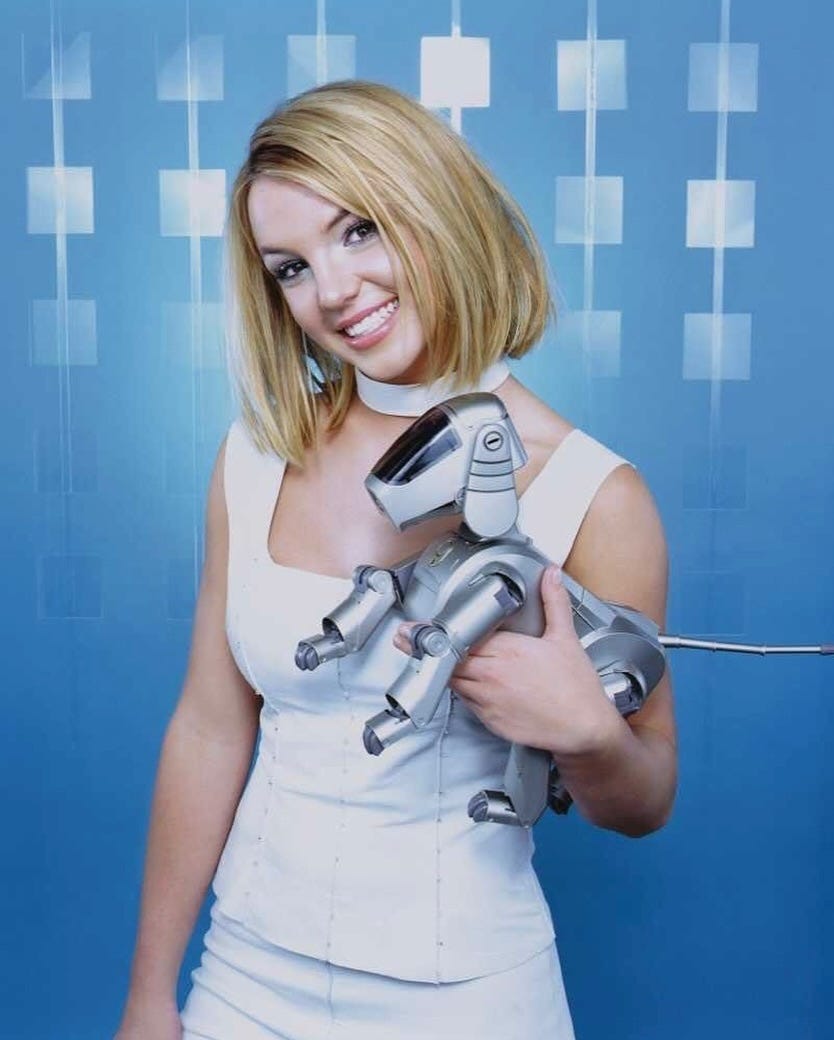
Or Frutiger Aero’s optimistic themes of technology in harmony with nature: landscapes of greenery, water fixtures, sky scrapers, fish, glossy translucency, bright colors, with a color palette of white, blue, and green. It was futuristic but human-centric and so… pure.

I’m not saying the world we have today isn’t worth living in, or even that it’s objectively worse than the 90s (I was born in ‘97 and therefore can’t really remember it) or the early 2000s (when the rose-colored glasses of childhood prohibit objectivity). But I don’t think it matters. We’re not actually making calculations or doing science here. These are the feelings that come from making peace with the disappearance of a bygone world. This is the process of catharsis.
Liminal spaces are a form of existentialist art emanating from humanity’s anxieties about a rapidly changing world and technological advancement, which have caused displacement and atomization.
Quick question, how’s your local mall doing? Does it even still exist, or has it been demolished at some point in the past 15 years? Liminality is the art of capturing a transitional period frozen in time—especially a place or thing that holds nostalgic significance—something of its time yet devoid of the crucial components that give it life. The most glaring of omissions is usually people.
Not all liminal spaces are mere stills of passageways designed to get from point A to point B. Many are creepy, disturbing, nostalgic, and strange because they invoke a sense of kenopsia: the eerie, forlorn atmosphere of a place that is usually bustling with people but is now abandoned and quiet. Sights of our childhood, of our third spaces, of pillars of the community, reduced to rubble.
I used to skate at the local roller rink, CN Skate Palace, in Aston, PA, every Friday night with my best friends throughout Middle School. It was like the teeny bopper club. Just LIT af with Justin Bieber blaring, the lights down low, and the flashing rainbow colors entrancing me until I braked for some pizza.
It was a family-owned rink opened in 1981. Everyone used to have their childhood birthday parties here up until the 2010s. Then, I guess, the crowds died down. People moved on? I think kids genuinely stopped skating. And going outside. It closed its doors in 2015, and the building was demolished some years later, replaced with storage units. But we still have its imprint on the world, which I like to revisit from time to time:
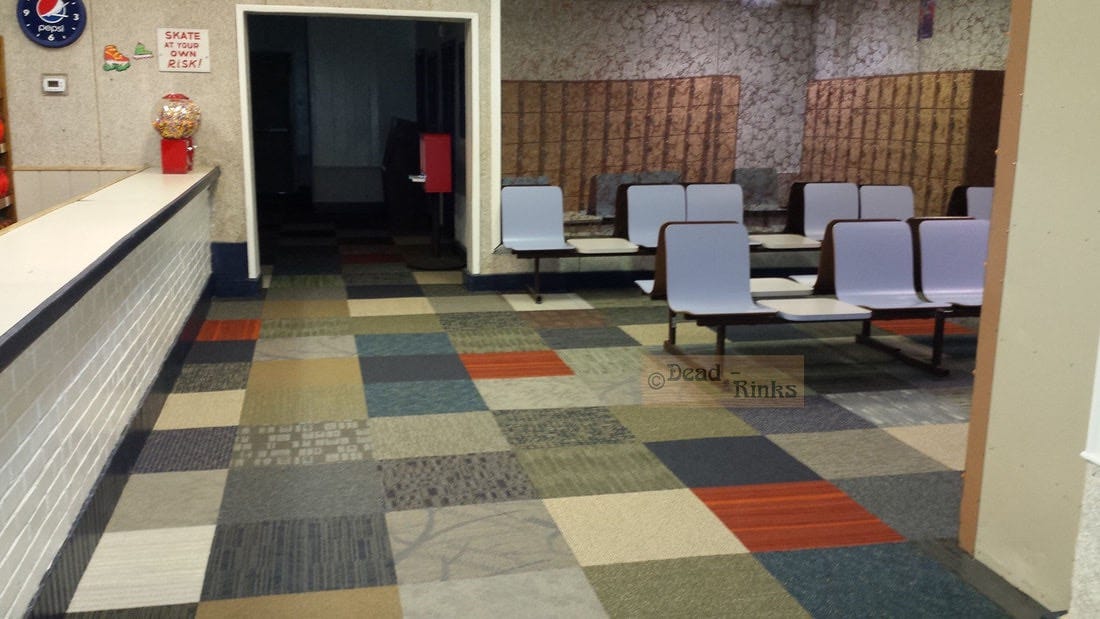
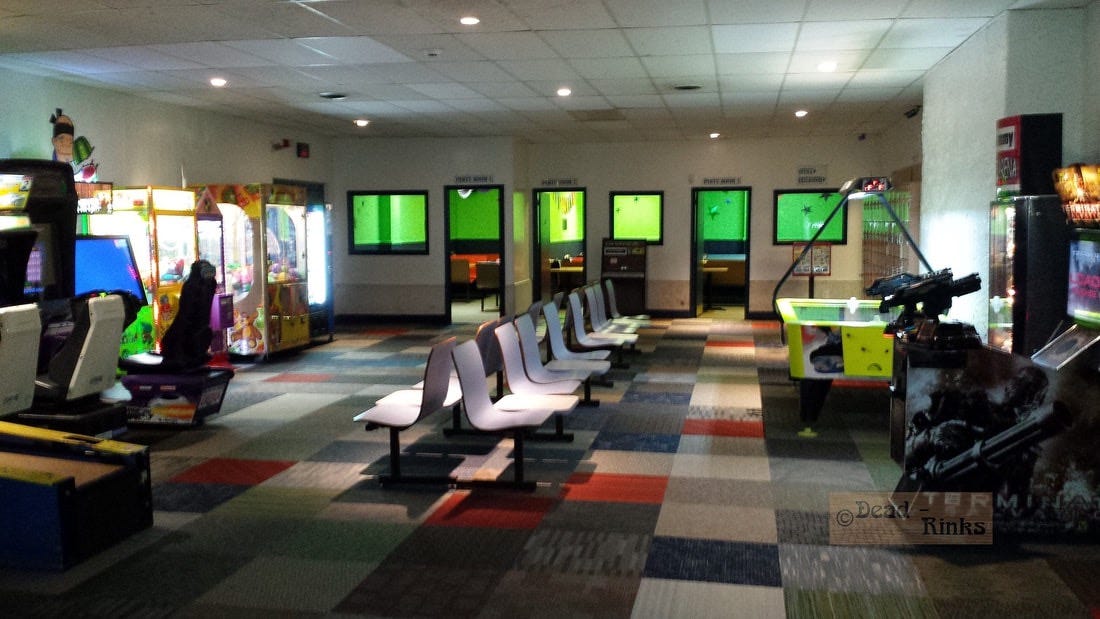
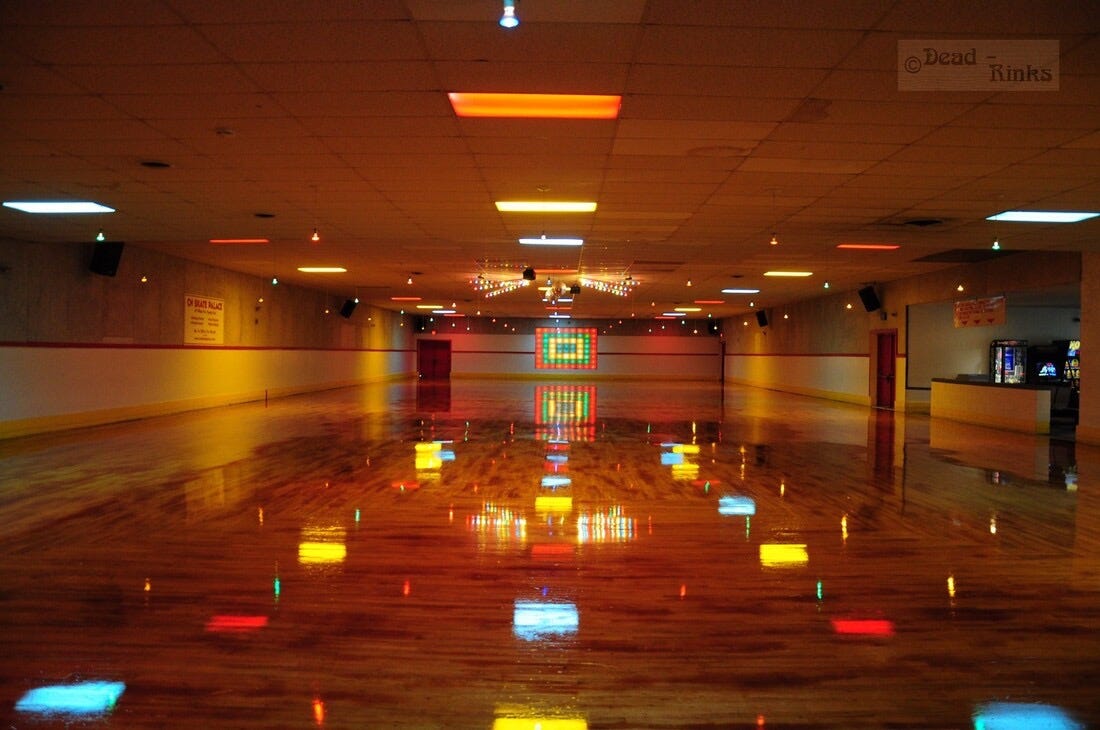
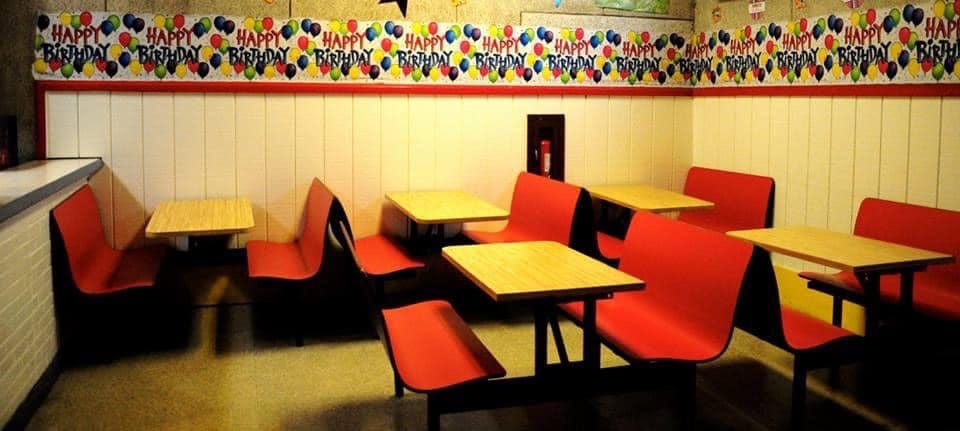
Now THIS is liminal nostalgiacore. Just feels like knives ripping right through me. There’s the counter where I’d get my blades, the mirror i’d watch myself in, the lockers I’d lock my stuff in (whatever stuff a preteen girl could possibly have), the arcade where I NEVER played any games, the beautiful rink in all its glory, and the booths where I’d get some respite from my skate-induced exhaustion and blisters with some greasy pizza and Middle School gossip.
One time, one of the boys who worked at this rink hit on me when I was like 13, so I eagerly went home and changed my Facebook relationship status to Taken, with the identity of the boyfriend in question being a total mystery to all who knew me, including the boy himself. But I wasn’t about to waste any street cred. We were boyfriend and girlfriend—whether he ever knew it or not—as far as the streets were concerned.
I can’t believe this place is just gone forever. These images I found from a roller rink archivist called Rink History look like they belong on a liminal spaces subreddit. I was touched to find someone in the business of archiving the past with such love and care, despite having no contextual connection to the actual place or community. They document all of the exterior and interior details with such love, care, and attention to detail.
“All very positive reviews. I never seen a single negative comment for this rink! Sounded like a good rink by the means of staff, the interior, whatever the reason. Sure most of you and I missed our chance to skate this one apparently. It was a very good rink,” they wrote. And it was a very good rink. Filled with good people.
And I find a sense of closure in knowing that there’s digital proof we existed in this little time and place, together. At the rink where so much more than skating happened. Where life happened. With people I hardly see anymore. Who live inside my memories like eternal ghosts whose images were once so violently palpable.
Likewise, I can’t believe my local mall, the place I used to inexplicably hang from beams to do “planking” challenges and hang out like a mallrat, is erased from the Earth. Replaced with luxury apartment buildings. It was the most bustling mall in the area for decades. I was practically raised in that mall. I used to do hoodrat shit with my friends in that mall :/
Social anthropologists and even we regular laymen have been foaming at the mouth to find the definitive dividing line between the generations of the before times and the generations of the after times. After times, of course, being this virtual hellscape we all find ourselves entrapped in, desperate for stimulus.
Actual photo of me:
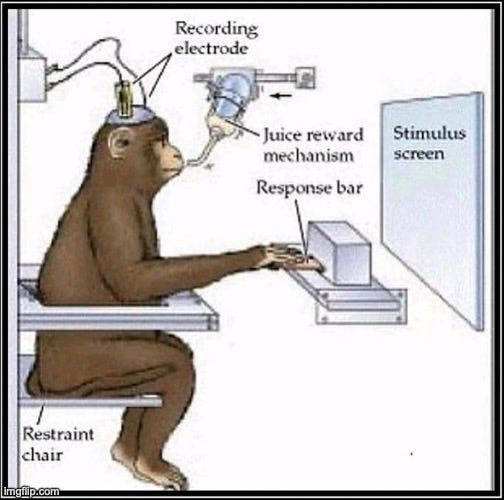
Well, you can all quit your desperate search and retract your naive contributions to the discourse. No one cares how old you were when the iPhone came out or just how much play time you managed to clock in during your childhood before black turtleneck man’s rectangle, and Zucc’s Never Disconnect With Anyone You’ve Ever Met In Your Entire Life platform invaded your malleable little brains and set up camp in there. I’ve pinned down exactly where it all went wrong.
The defining moment, the generational marker, the era that once was but can never again be, is all neatly wrapped up in a fixture of Americana, aptly representing consumerist glory: the mall. Kevin Smith understood just how powerful the mall was; 90s media would have you believe no one actually owned homes. They just lived in the mall, with the exception of Natalie Portman, who lived in the more budget-friendly Walmart.
The point is, you guys have it all wrong. The dividing line is this: Have you now, or in the past, experienced being a mallrat? And I mean a rat that’s downright FERAL for the mall. All your friends are there. They’re ALWAYS there. Where else would they go, and what else would they be doing? Stores aren’t closed. Bands PERFORM there. If you were in the right place at the right time, you probably got a free show from Britney fucking Spears. And this was a normal Thursday.
You would sneak into the gag gift section at Spencer’s and giggle your little 13-year-old brains out at the sight of seeing a SEX TOY in the flesh, no pun intended. It was all so confronting in an innocent and harmless way. Now, the average age of first-porn viewing is 12 years old. And a significant minority (15%) report exposure to pornography before 10 years old.
The mall wasn’t just a place; it was a lifestyle. It was the world. It was the culture. It was, certainly, the teenage third space that influenced so many films that were produced in the 80s and 90s, revolving around loitering in the food court, nerding out in the video store, harassing security, getting into an embittered argument with your school peers, and having the obligatory meet-cute with your crush. It was the last stand of people-focused culture.
But then, the internet happened. I mean, obviously, the internet had already happened, but it hadn’t yet happened. The computer was, at once, a place, usually occupying space in its own designated room. You went to it. In 2008, a peculiar futuristic little rectangle with admittedly ugly icons but a visionary idea changed the world. Within two years, its popularity soared, and humanity hasn’t recovered ever since. Oops!
But all eras come to an end. After more than forty years in business, the Granite Run Mall, affectionately known as “G-Run,” officially closed in 2015 and was demolished a year later. It was like a vestige of the past, with its 70s shell and 90s-renovated interior. A relic of a bygone era. It was magical. A way of life.

It had all my favorite stores. The vibes of the place were immaculate. The food court, ahhh, the Panda Express. The glimpses of the immaculate Christmas displays in the Winter, as I peered over the railings to see Santa and the sprawling decorations, the garlands transforming boring railings into a festive occasion. The wrapping stations in Boscov’s, where my dad would take me along to watch an ordinary-looking brown box be transformed into something pristinely wrapped and festive, adorned with a bow.
How the music echoed through all its corridors, and I experimented with regrettable aesthetics in its merchandise. The magic that filled the air. The sense that anything could happen there. It really was like living in Mallrats. Funnily enough, Kevin Smith scoped this place out circa 2015 as a potential shooting location for Mallrats 2, and he was pretty set on filming there if it weren’t for the developers’ planned demolition schedule getting in the way of the shoot.
He had excitedly announced that he had found their mall, only to move on to the mall in Exton after this one didn’t pan out. A full decade later, and there is still no Mallrats 2 to speak of. And no Shannen Doherty anymore, either. Sad, but that’s the power that G-Run held. It’s the glue that kept mall culture running. Now, sadly, that glue has given out. No G-Run, no Mallrats cinematic universe. Feel the impact!!
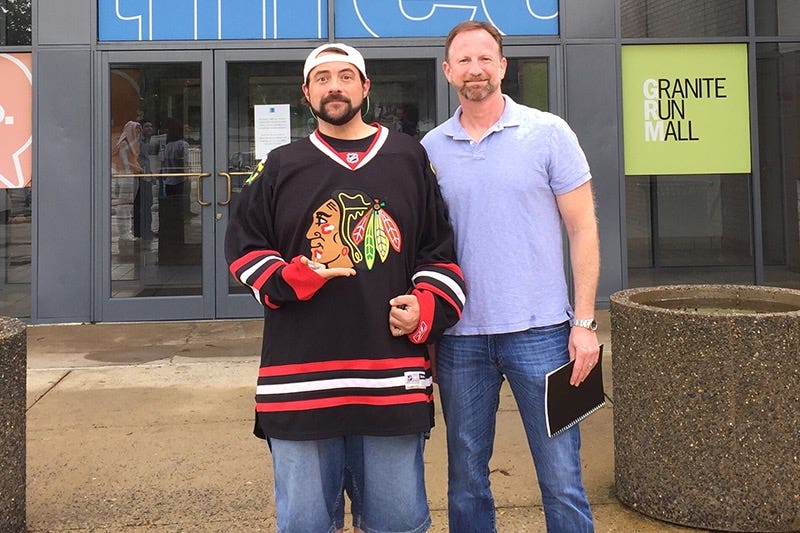
Even this beacon of Delco civilization was ill-fated, just like all the other malls of America, to Dead Mall status. Kids didn’t hang out here anymore. No one really shopped at stores in person. Everything was ordered online. Slowly but surely, everything started to close. Enter: The Fall.
It always starts with Hot Topic for some reason. The goths seem sensitive to retail extinction. Then domino hits domino, and before we knew it, the only stores left standing were Boscov’s and Sears. It ended the same way it always does: erasure. But that in-between stage, past its life cycle but before it’s been buried, well, that’s where liminal spaces live.
The mall at the end:
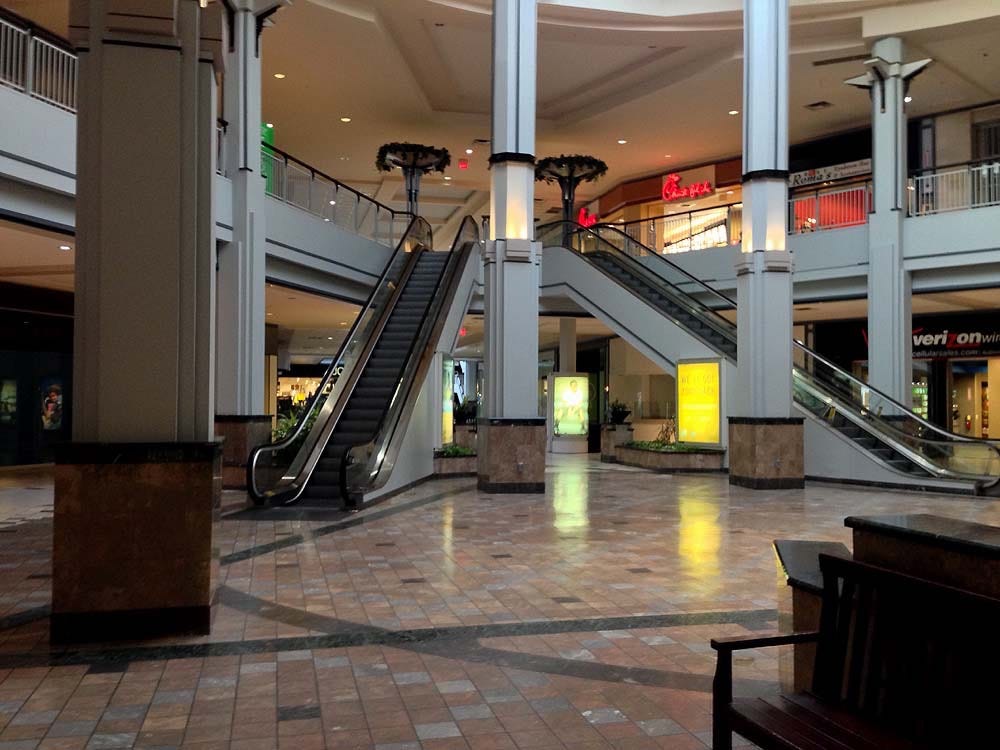
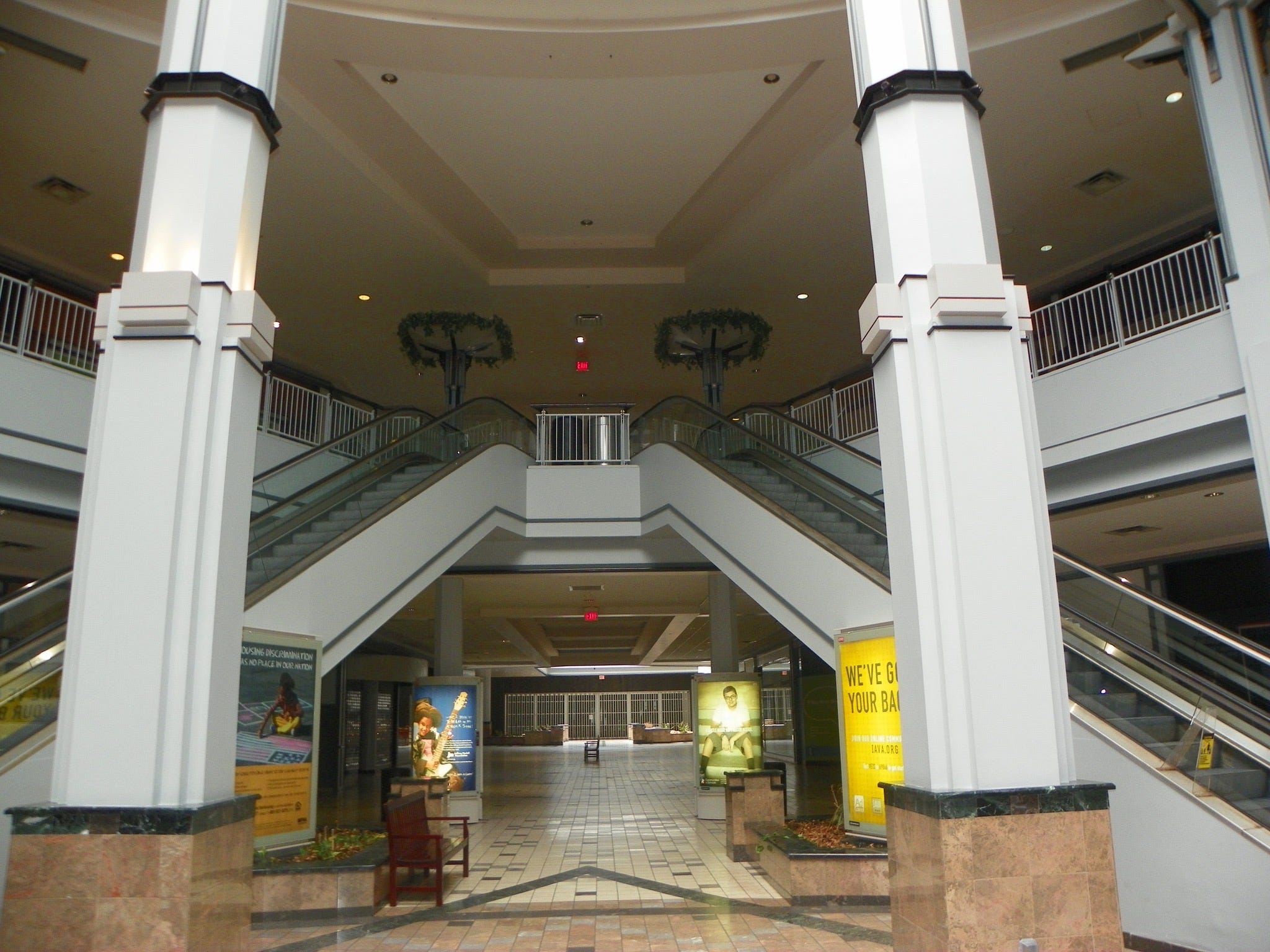
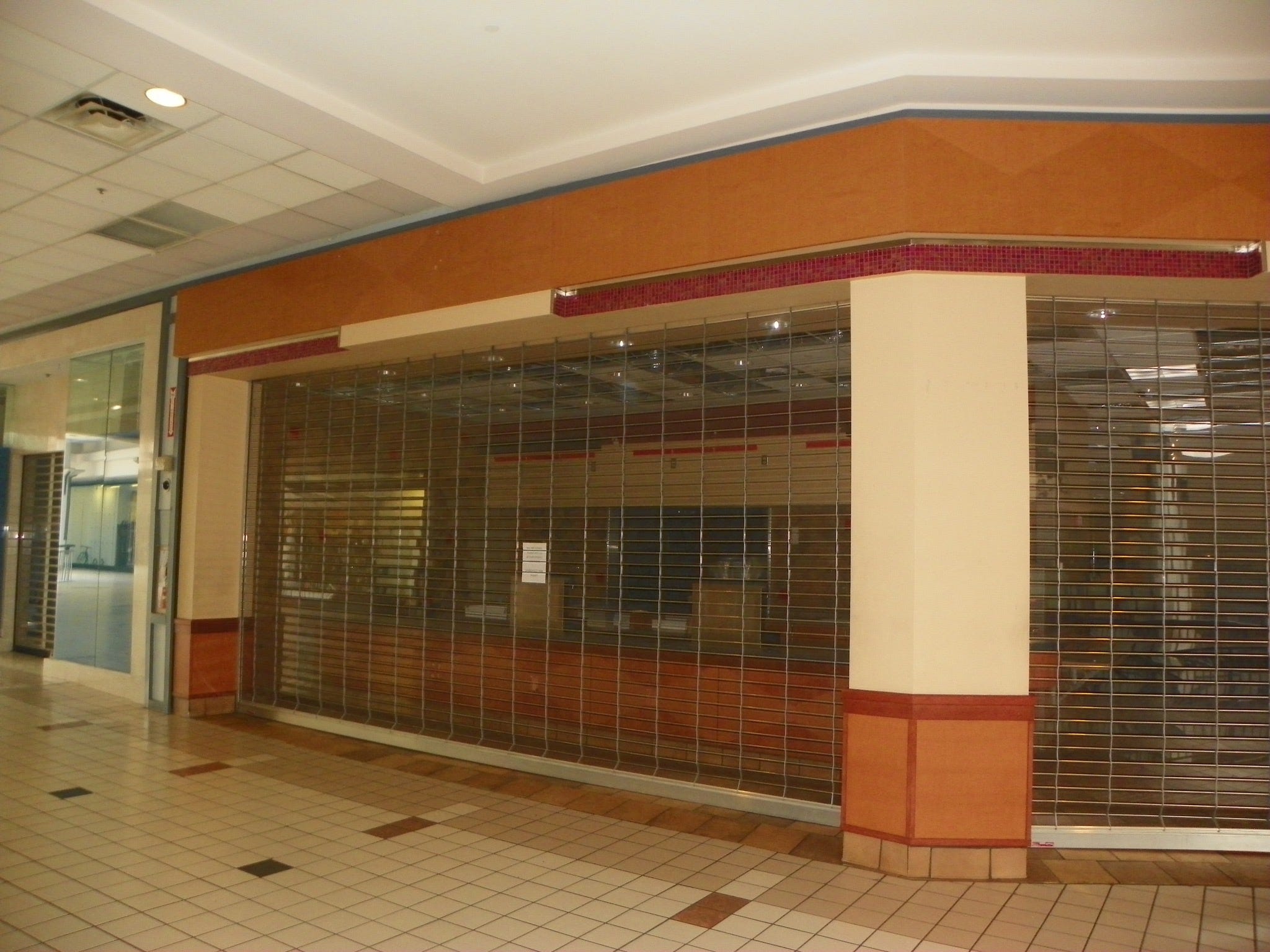
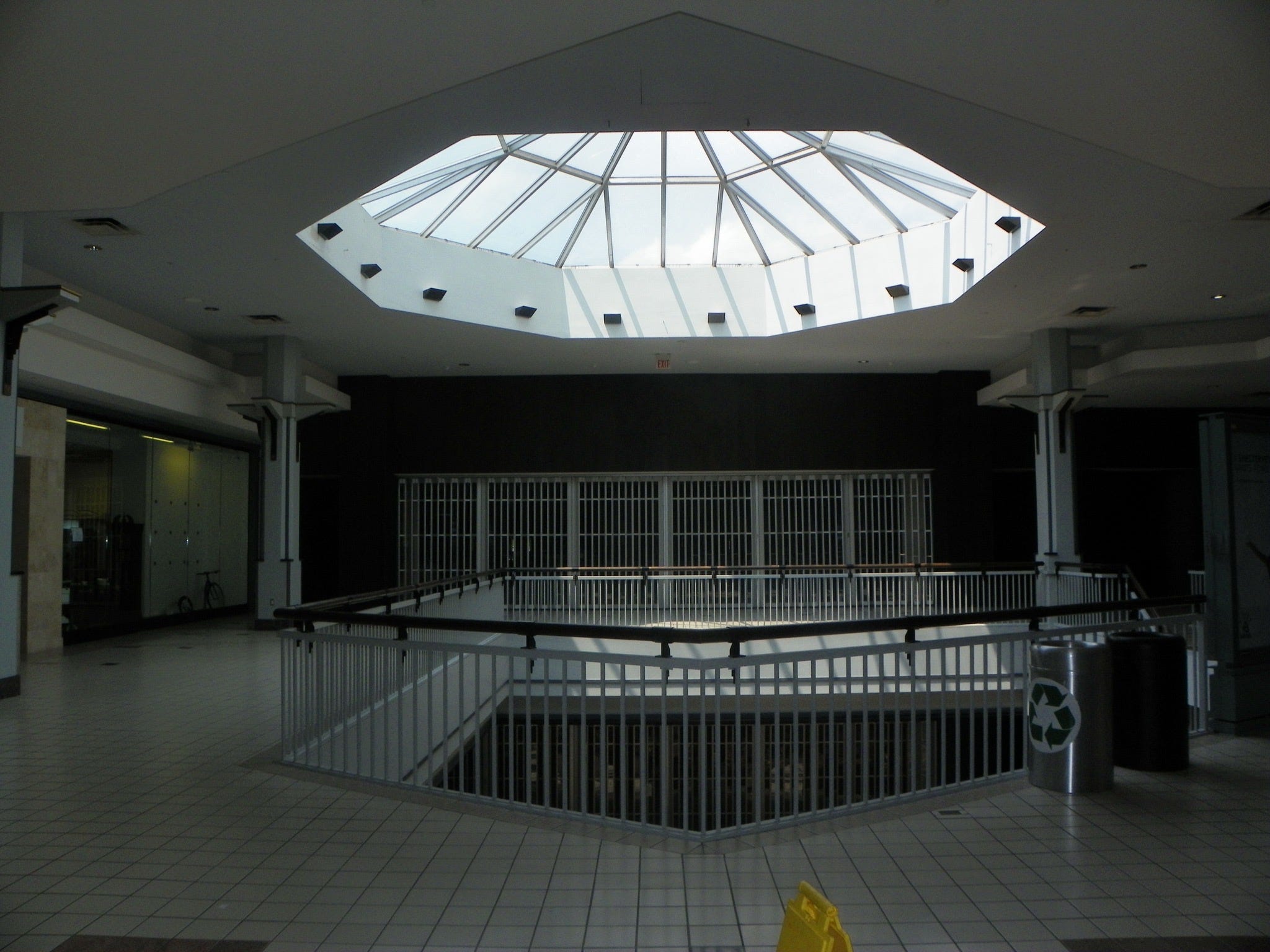
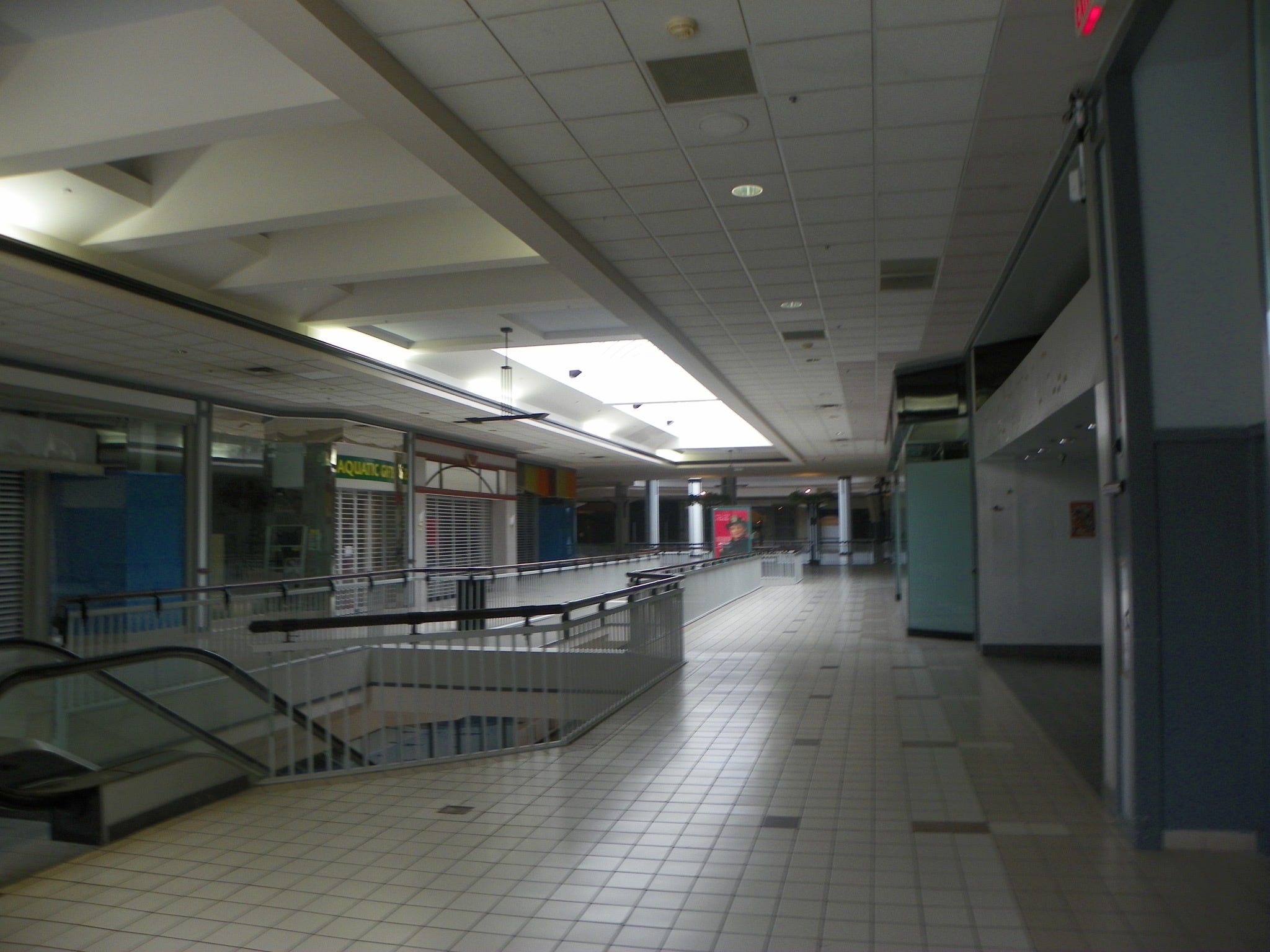
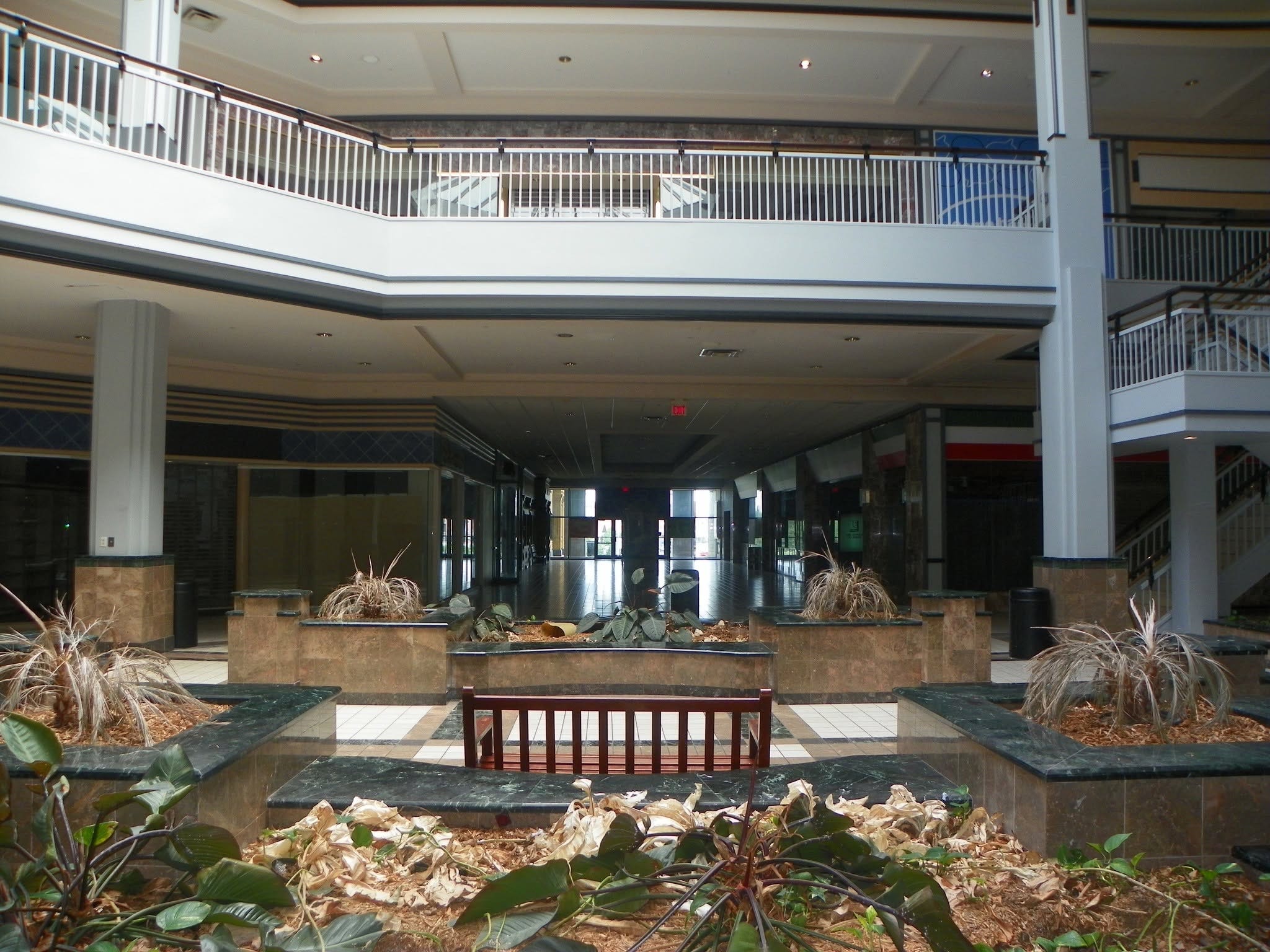
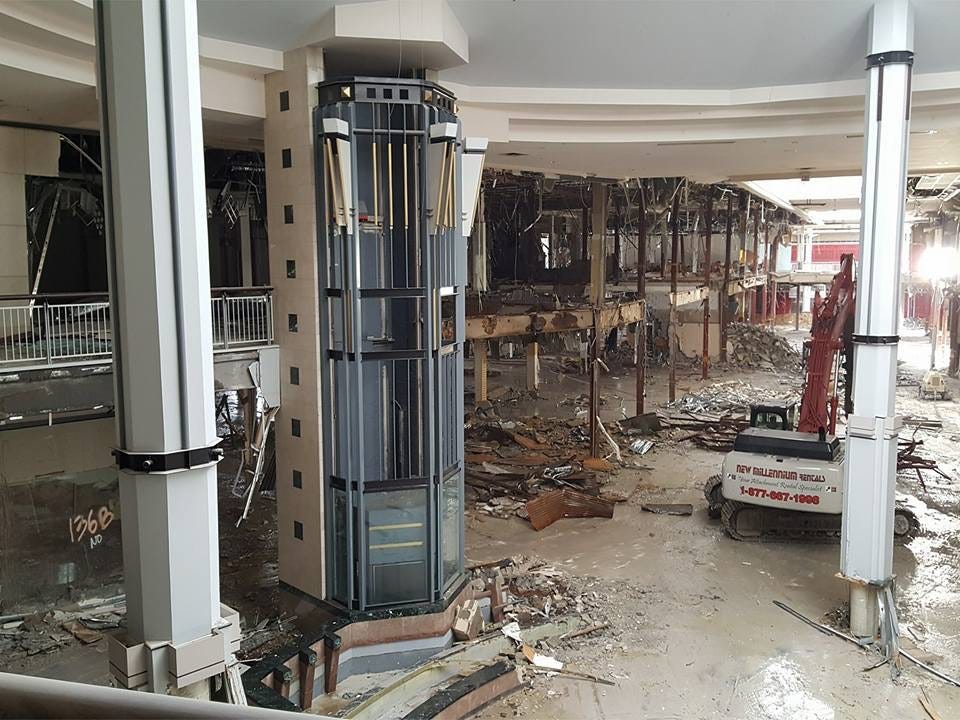
This mall was so beloved and such a cornerstone of the community that there are entire Facebook groups dedicated to reminiscing over it, spanning an impressive diversity of generations. It’s here that I discovered incredibly upsetting lore like the fact that DESTINY’S CHILD casually performed at this mall in 2000, when Beyonce was just 19. I can forgive my oversight, as I was, after all, just a 3-year-old child.
But then I learned that the JONAS BROTHERS performed here in 2007 before they had their big breakout, when I was OBSESSED with the Jonas Brothers around this era and literally used to call their hotline every day, leaving voicemails, giving Nick my condolences over his life-threatening illness (diabetes). So I must not have been locking the fuck in. What the hell, girl? See what happens? You miss your moment. That Ferris Bueller quote, and all.
Parsons, himself, has dealt with a similar local tragedy. Having posted a number of different artistic projects on his YouTube channel through the years, besides his Backrooms series, one particular video caught my eye. Posted just two years ago, in 2024, it was titled “The Remains of Valley View Mall (Post-Demolition).”
Through the melancholic wandering through rubble, communicated only through a lingering camera lens and interposed images of what sections of distinctly branded flooring had once looked like in context, in its full American mall glory, I felt connected. Indeed, we have seen the fall of so many classic American institutions.
The fall that we’ve all witnessed, but which hit young people especially hard because of the feeling that society, community, life as we know it, is headed towards permanent regression, and that we arrived just as the lights were being turned out, the store closing for the last time, the ritual pastime near-unanimous to the American way of life, just entirely withheld from our reach.
And not even the internet is safe from this decline, as it no longer feels like the exciting Wild West it did in its early days and now just feels like Dead Internet, creating a weird paradox where even the digital world doesn’t feel “real” enough.
The Institutional Gothic
You’ll notice it’s difficult to come up with an unobjectionable, all-encompassing definition for liminal spaces. It’s not just a lack of people or things out of their original context. It has a distinct mood it casts on the viewer, which is perhaps most important. One that asks you to remember when life felt embodied and real, and it almost invites you back, even though it’s some transitional space frozen in time, devoid of all life.
By virtue of being empty and lifeless, it exists in this bizarre state of incomprehensibility. It’s a place built for community and life, and yet, there is no life to be found. We feel a sense of sadness for the space and its newfound redundancy, and we promise to properly mourn it—to keep its memory alive. I think we empathize with and feel especially disturbed by these spaces because there is a new, lingering anxiety that what’s happened to them is about to happen to us.
What if humans, too, are being ripped out of their ordinary context and function? We’re redefining our roles in the world. Young people are delaying milestones that have historically demarcated the line between childhood and adulthood, including getting driver’s licenses, moving out of their parents’ house, getting married, and having children.
That leaves a civilization grappling with what life means stripped of its ordinary arc, rites of passage, and, for many people, meaning. We’re left philosophically pondering these liminal spaces, confronted by the absurdity of an arcade or bowling alley or a mall, its infrastructure built for people left standing in itself, much like we’re grappling with what it means to live, to have consciousness, and to lead a “meaningful” life that matters stripped of the ordinary things we’re relied on to give us meaning throughout all of human history.
“What if we’re forgotten, like this bowling alley? What if I should stay behind, and waste away in this Chuck E Cheese, before it all happened?” It is photographic angst, and perhaps the most deserved angst next to the Cold War’s impending threat of doom. Because in a way, we fear something even more disturbing than imminent death. Death is a form of closure. It is clearly defined and has a finality to it. It knows what it is. It inspires no confusion.
It’s imminent liminality, with no knowledge of what comes next, that unsettles us. Like that feeling you get when you’ve been on vacation for too long or unemployed for a few months or a cold that’s lingered for longer than you can bear, so you start to pray to God even though you’re an atheist to please stop the sniffles, and you’ll suddenly lead an honest-to-God Christian life (maybe that’s just me).
There’s this desperation in getting out, even if it means reverting to the old rat race. At least there would be closure, certainty, and purpose. This infinite nothingness, this infinite not-knowing, is unbearable. There’s something particularly American about it, too. Because we’re confronted by the fact that all our most prized nostalgia revolves around corporations, consumption, and a kind of goofy goober capitalism.
And I love me some capitalism. Like, seriously and unironically. I perma-roll my eyes when I hear the term “late-stage capitalism.” But there is something civilizationally hollow about the burden of community and connection being carried on the back of McDonald’s golden arches and the local mall being called upon to solve suburban sprawl.
I think that contributes to the uncanny valley feeling. Feeling so connected and desperate to revive a sort of satirical idea of what American life is: a series of retail stores with signature products. It’s like feeling called back to The Truman Show. “I sure do miss the local Havana Cabana Bonanza Rama Jama in Osh Kosh Whereverthefuckkk, they had the best purple pita piper picked his peppers for just $4.99!! Kids these days don’t know what they’re missing.”
The Functional Melancholic raised a beautiful point about pinpointing what a seemingly unassuming room in these spaces does to us emotionally.
“The room was built with a kind of promise to bring people there, give them a purpose, move them through, and that promise, for whatever reason, has been suspended. So, I think what you’re looking at is the architecture of meaning without the meaning in it. There’s something about that. Maybe something in the lizard brain, or maybe something even more recent than that, that reads this as a threat.
Because if the scaffold can exist without the thing it was built to hold, then maybe the thing it was built to hold wasn’t as solid as you thought, and maybe this means you’ve been walking around inside a structure your whole life and calling that structure ‘real life.’ I think that’s an uncomfortable thought in a shopping mall, but I’d wager it’s almost unbearable in an office space at 11 pm with the screen saver cycling and the half-empty mug on the desk.”
Shira Chess, writer and Associate Professor of Entertainment Media Studies at the University of Georgia writes in The MIT Press Reader, about the backrooms functioning as part of a new genre she’s dubbed the Institutional Gothic, where the Gothic genre having always centered around the return of the past on the present or the sins of older generations rearing their ugly head on the young, they had traditionally taken the form of “crumbling aristocracies set in dramatic, desolate landscapes filled with monstrous antagonists, terrified heroines, fragmented narratives, and the supernatural.”
“But where the traditional Gothic is dark and looming with ornate architecture, the Institutional Gothic occurs in winding or otherwise empty office spaces, consumed by machine-made mundanity and the unforgiving gaze of noisy overhead fluorescent lighting. The antagonists, once bloodthirsty lords, are instead soulless corporations. The protagonists, once women at the mercy of those lords, are now often white men, wandering fearfully or uncomfortably through those catacombs. Taken together, the Institutional Gothic transforms a genre once fueled by phantasmal terror into the familiar, worldly dread of workplace alienation.”
Chess argues that if traditional Gothic is about the sins of the past revisiting the present, then the Institutional Gothic echoes that trope by focusing not on the class-based horrors of 200 years ago, but on the (still class-based) corporate choices made within the 20th century that resulted in middle class alienation and abandonment by Corporate America—hence the office spaces as manifestations of inescapable traps buzzing with fluorescent light.
She broadens the theory by reminding the reader that the monsters in these stories, like Frankenstein, were never the true monsters; it was always the creator. In the case of the backrooms or liminal spaces, the creator is the efficiency-seeking corporation, whom Shelly blames for their indifference to environmental destruction and human harm, for getting us to where we are now. “Like a hydra, they cannot be killed; they just re-form under a new head.”
I assume by this she means that the same underlying philosophy that led to widespread middle-class alienation by corporate America in a more mundane way is to blame for the eventual outsourcing of all human creation and value as we head into the fourth technological revolution and contend with being replaced by AI. Chess says that as we reconcile with our lost spaces and our offices give way to new “lifeforms,” such as billion-dollar data centers for AI and cloud computing, liminality will continue to define this threshold moment between physicality and digitality.
This last line is especially evocative, and the aspect I most agree with. Where I think she is thinking too narrowly is in blaming this phenomenon of the newly emerging Institutional Gothic (a name I find really poignant) on corporate America. There is, of course, some overlap in my own observations of the elements of inherently consumer capitalist Americana being imbued within these aesthetics, but I think that corporate America is not really what we’re mourning or disturbed by here; it’s slightly broader.
It’s the loss of institutions, which is why liminal spaces span subject matter far more diverse than just office spaces. They can be pools, jungle gyms, living rooms, malls, school hallways, universities—institutions that once structured human life. With the fall of these institutions and the collapse of monoculture, it does feel like we’re straddling, as Chess puts it, “the threshold between physicality and digitality.”


This post on X reminded me of the opening of The Sopranos, when we’re introduced to the titular character, Tony Soprano. He tells his therapist, Dr. Melfi, “It’s good to be in something from the ground floor. I came too late for that, I know. But lately, I’ve been getting the feeling that I came in at the end. The best is over.” Dr. Melfi tells him, “Many Americans, I think, feel that way.”
Tony goes on, “I think about my father; he never reached the heights like me, but in a lot of ways, he had it better. He had his people, they had their standards, they had pride. Today, what do we got?” The golden age Tony longed for both did and didn’t exist. It’s true that the mafia was in decline as Tony came up; that “made” men, in some ways, commanded more respect; that they had stronger ethnic enclaves back in the day, less surveillance, and fewer informants.
But Tony also romanticizes the old days because he idealized his father and saw him through a child’s lens. Rather than seeing a violent, unfaithful criminal who constantly scapegoated the mother and was tearing apart his family, Tony chose to see his father as an all-powerful, loyal, ultra-masculine tough guy who embodied the way things ought to be, while blaming everything that ever went wrong on his mother.
It’s true to say that Tony has a delusional, rose-colored view of the past and fails to see it for what it was. But nostalgia isn’t all false. Oftentimes, the things people long for and resent not getting to experience really were, in some narrow sense, better than they are today. Just not in all ways. Take the luxuriousness of Pan Am flights in the 60s. Flying like most modern people have never experienced. Unambiguously superior aviation. But it was also extremely cost-prohibitive.
So, we traded the luxurious fine-dining, ultra-comfortable experience for accessibility and cost-effectiveness. Now, air travel isn’t just for the ultra-wealthy; it’s for everyone. And yet, everyone commiserates over how much it utterly sucks (I’ll keep my mouth shut because I actually quite like the whole “drudgery” of air travel).
While I get the inclination for nostalgia skeptics to truth nuke/nvke young people for being overly wistful with reality checks like “you weren’t even there,” “it was never actually that good”, or “you only think so fondly of it because you were a child,” I think that really misses something. Nostalgia is not meaningless nonsense; it’s just missing the full picture. We remember vividly what was superior about it and less vividly what was inferior.
Two things can be true at once, though. We can be better off moving forward, while knowing that something of value is inherently lost in the process, and it’s not supposed to feel good. I’m a strong believer in dialectics. I think we need the liberals and the conservatives. The progressives and the traditionalists. The capitalists and the socialists. The creative andthe practical. The nostalgic and the unsentimental.
It feels difficult to properly weigh these tensions against each other in such a rapidly changing world. It feels like there are fewer choices. Like, get with the program or become obsolete. And I’m not even a techno-pessimist! I have used AI billions of times, especially to write emails. I previously used it to generate a thumbnail for my Substack, which really set some people off. But it’s less clear what we’re heading to or what we’re advocating for on the techno-optimist side. It really does require incredible caution. Jobs are being, if not automated, at least redefined or restructured by AI.
It’s unclear how humans will factor into a society that becomes oriented around ~machine~ even without the elephant in the room: dropping TFR, meaning we need to seriously rework how the hell we support ourselves in old age, like, yesterday, since we’ll no longer have enough people to pay into these systems and keep them solvent. When we look at these spaces, I think we feel like the space itself. Stripped of their ordinary function and context, made redundant. Forgotten. There’s a shared understanding with it. We think, “What if we become like these spaces, too?”
If the anthropologists that developed the very concepts of liminality have anything to say about it, though, it’s that liminality is an inherently temporary state that cannot last forever. For now, we can share a theater together, experience communitas with our fellow lost travelers, and indulge in the sado-masochism of looking at sad, familiar images. We’ll rebuild tomorrow.
This is a really great piece. I'm twenty years older than you, and I can feel that nostalgia going back to an even *earlier* time: I've often said it, but parts of my childhood (maybe the parts I remember best?) would not have been out place in - and allowed me to viscerally connect with - childhood stories that take place in the 1950s, even the 1930s. The Change came slowly, then all at once ... I would have a lot more to say about it, but here, just to drop you this: when I was doing my graduate research work here in France, I came across this 1992 book by Marc Augé called "Non-lieux" (Non-places). The title is also a play on the French legal system idea of a "non-lieu" :
("At the end of their investigation, the investigating judge either refers the case to the trial court (ordonnance de renvoi) or issues an ordonnance de non-lieu (a "no-case" judgement). The latter happens when the evidence gathered by the investigation does not justify further action. - Wikipedia).
There's something interesting about that also: it didn't happen. "Avoir lieu" is "to take place" (event). So a "non-lieu" is something deemed to "not have sufficient evidence for further action". It "didn't happen" ...
Anyway, I went to see if there was an English translation to share, in case you're interested, and lo and behold, the Internet delivereth!
https://monoskop.org/images/3/3c/Auge_Marc_Non-Places_Introduction_to_an_Anthropology_of_Supermodernity.pdf
This competing with the Amazing Digital Circus finale. I’ll probably choose this.